Cephalopoda |
Oegopsida |
Ommastrephidae | Ommastrephinae
Umwelt: Milieu / Klimazone / Tiefenbereich / Verbreitungsgebiet
Ökologie
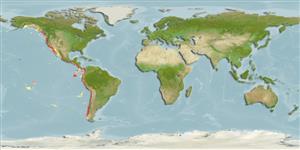
Pelagisch; ozeanodrom (Ref. 87829); tiefenbereich 0 - 2000 m (Ref. 138555). Tropical; 4°C - 32°C (Ref. 1982), preferred 26°C (Ref. 107945); 60°N - 57°S, 169°W - 70°W
Eastern Pacific. From south of Bering Strait to Gulf of Alaska, east to Gulf of California and south to Chile. Tropical to boreal.
Länge bei der ersten Reifung / Größe / Gewicht / Alter
Geschlechtsreife: Lm 29.7 range ? - ? cm Max length : 400 cm TL Männchen/unbestimmt; (Ref. 275); common length : 80.0 cm TL Männchen/unbestimmt; (Ref. 275); max. veröff. Gewicht: 3.0 kg (Ref. 275)
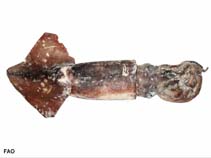
Common total length: 50 to 80 cm. Caught by jigs (Ref. 275). Maximum total length is 4 m. Common length is about 50 to 80cm (Ref. 3722). Are considered as one of the straddling stocks in the eastern central Pacific (Ref. 87829). Inhabits offshore areas of continental shelves from surface to depths of at least 1200 m. Found over the shelves and near shores during feeding. Adults undergo diel vertical migrations with a night lift to the 0-200 m water layer, going down at daytime to depths of 800-1,000 m and deeper (Ref. 2130). Upper temperature limits range from 30 to 32°C in equatorial areas, while deeper water temperature limits are not less than 4 to 4.5°C. Active predator, feeds actively at dusk and dawn. Commonly feeds on copepods, hyperiid amphipods, euphausiids, pelagic shrimps and red crabs (Pleuroncodes planipes), heteropod mollusks, squid, octopods and various fish. Exhibits cannibalism, but only on juvenile squids (Ref. 1982). Its range extension off central California led to the decline of Merluccius productus (Ref. 138555).
Lebenszyklus und Paarungsverhalten
Geschlechtsreife | Fortpflanzung | Ablaichen | Eier | Fruchtbarkeit | Larven
Members of the class Cephalopoda are gonochoric. Male and female adults usually die shortly after spawning and brooding, respectively. Mating behavior: Males perform various displays to attract potential females for copulation. During copulation, male grasp the female and inserts the hectocotylus into the female's mantle cavity where fertilization usually occurs. Life cycle: Embryos hatch into planktonic stage and live for some time before they grow larger and take up a benthic existence as adults.
Roper, C.F.E., M.J. Sweeney and C.E. Nauen 1984 FAO Species Catalogue. Vol. 3. Cephalopods of the world. An annotated and illustrated catalogue of species of interest to fisheries. FAO Fish. Synop. 125(3):277p. Rome: FAO. (Ref. 275)
IUCN Rote Liste Status
(Ref. 130435: Version 2025-2 (Global))
CITES Status (Ref. 108899)
Not Evaluated
Not Evaluated
Bedrohung für Menschen
Nutzung durch Menschen
Fischereien: kommerziell
FAO - Fischereien: Artbeschreibung, landings search; Publication: search | FishSource | Das Meer um uns herum
Tools
Mehr Information
PhysiologieSauerstoffverbrauch
MenschenbezogenBriefmarken, Münzen, Verschiedenes.
Internet Quellen
Schätzungen auf der Grundlage von Modellen
Widerstandsfähigkeit
(Ref. 69278): |
hoch, Verdopplung der Population dauert weniger als 15 Monate. (K=0.17-1.2; tm=0.53) |
Rate of population increase
|
Prior r = 1.19, 95% CL = 0.79 - 1.79, Based on 2 data-limited stock assessments. |
Anfälligkeit der Fischerei
(Ref. 71543) |
Moderate to high vulnerability (46 of 100). |
Klimaanfälligkeit
(Ref. 125649) |
Moderate vulnerability (38 of 100) |
Preiskategorie
(Ref. 80766): |
Low. |
Nutrients
|
Calcium = 126 [75, 177] mg/100g; Iron = 4.79 [1.67, 7.92] mg/100g; Protein = 15.5 [13.7, 17.4] %; Omega3 = 0.414 [0.262, 0.566] g/100g; Selenium = 57.8 [48.5, 67.2] μg/100g; VitaminA = 0 μg/100g; Zinc = 1.97 [0.92, 3.02] mg/100g (wet weight); based on nutrient studies. |