Cephalopoda |
Oegopsida |
Ommastrephidae | Ommastrephinae
Lingkungan: lingkungan / zona iklim / kisaran kedalaman / jangkauan distribusi
Ekologi
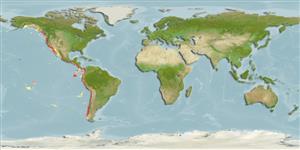
Pelagis, permukaan; oceanodromus (Acuan 87829); kisaran kedalaman 0 - 2000 m (Acuan 138555). Tropical; 4°C - 32°C (Acuan 1982), preferred 26°C (Acuan 107945); 60°N - 57°S, 169°W - 70°W
Eastern Pacific. From south of Bering Strait to Gulf of Alaska, east to Gulf of California and south to Chile. Tropical to boreal.
Panjang pada saat jatuh tempo pertama / Ukuran / Berat / umur
Kematangan: Lm 29.7 range ? - ? cm Max length : 400 cm TL jantan/; (Acuan 275); common length : 80.0 cm TL jantan/; (Acuan 275); Berat maksimum terpublikasi: 3.0 kg (Acuan 275)
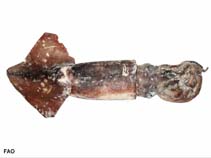
Common total length: 50 to 80 cm. Caught by jigs (Ref. 275). Maximum total length is 4 m. Common length is about 50 to 80cm (Ref. 3722). Are considered as one of the straddling stocks in the eastern central Pacific (Ref. 87829). Inhabits offshore areas of continental shelves from surface to depths of at least 1200 m. Found over the shelves and near shores during feeding. Adults undergo diel vertical migrations with a night lift to the 0-200 m water layer, going down at daytime to depths of 800-1,000 m and deeper (Ref. 2130). Upper temperature limits range from 30 to 32°C in equatorial areas, while deeper water temperature limits are not less than 4 to 4.5°C. Active predator, feeds actively at dusk and dawn. Commonly feeds on copepods, hyperiid amphipods, euphausiids, pelagic shrimps and red crabs (Pleuroncodes planipes), heteropod mollusks, squid, octopods and various fish. Exhibits cannibalism, but only on juvenile squids (Ref. 1982). Its range extension off central California led to the decline of Merluccius productus (Ref. 138555).
Siklus hidup dan perilaku kawin
Kematangan | Reproduksi, perkembang biakan | Pemijahan | telur-telur | Fekunditas | Larva
Members of the class Cephalopoda are gonochoric. Male and female adults usually die shortly after spawning and brooding, respectively. Mating behavior: Males perform various displays to attract potential females for copulation. During copulation, male grasp the female and inserts the hectocotylus into the female's mantle cavity where fertilization usually occurs. Life cycle: Embryos hatch into planktonic stage and live for some time before they grow larger and take up a benthic existence as adults.
rujukan utama
Acuan | Koordinator | mitra
Roper, C.F.E., M.J. Sweeney and C.E. Nauen 1984 FAO Species Catalogue. Vol. 3. Cephalopods of the world. An annotated and illustrated catalogue of species of interest to fisheries. FAO Fish. Synop. 125(3):277p. Rome: FAO. (Acuan 275)
Status IUCN Red List
(Acuan 130435: Version 2025-2 (Global))
status CITES (Acuan 108899)
Not Evaluated
Not Evaluated
ancaman kepada manusia
penggunaan manusia
Perikanan: komersial
FAO - Perikanan: profail spesis, landings search; Publication: search | FishSource | Laut di Sekitar Kita
Alat, peralatan
informasi lanjut
FisiologiKonsumsi oksigen
Yang berhubungan dengan manusiaPerangko, koin, dll.
Sumber internet
Estimasi berdasarkan model
Daya lenting
(Ref. 69278): |
Tinggi, Waktu penggandaan populasi minimum kurang dari 15 bulan (K=0.17-1.2; tm=0.53) |
Rate of population increase
|
Prior r = 1.19, 95% CL = 0.79 - 1.79, Based on 2 data-limited stock assessments. |
Kerentanan Penangkapan Ikan
(Acuan 71543) |
Moderate to high vulnerability (46 of 100). |
Kerentanan Iklim
(Acuan 125649) |
Moderate vulnerability (38 of 100) |
kategori harga
(Acuan 80766): |
Low. |
Nutrients
|
Calcium = 126 [75, 177] mg/100g; Iron = 4.79 [1.67, 7.92] mg/100g; Protein = 15.5 [13.7, 17.4] %; Omega3 = 0.414 [0.262, 0.566] g/100g; Selenium = 57.8 [48.5, 67.2] μg/100g; VitaminA = 0 μg/100g; Zinc = 1.97 [0.92, 3.02] mg/100g (wet weight); based on nutrient studies. |