Cephalopoda |
Oegopsida |
Ommastrephidae | Ommastrephinae
Entorno: milieu / zona climática / rango de profundidad / gama de distribución
Ecología
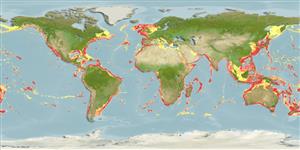
Bentopelágico; oceanodromo (Referencia 87829); rango de profundidad 0 - 2200 m (Referencia 275). Subtropical; 10°C - 25°C (Referencia 97142), preferred 25°C (Referencia 107945); 79°N - 48°S, 180°W - 180°E
Circumglobal in subtropical and polar oceanic waters.
Longitud en la primera madurez / Tamaño / Peso / Edad
Madurez: Lm ?, range 40 - ? cm Max length : 45.0 cm ML macho / no sexado; (Referencia 97142); 90 cm ML (female); peso máximo publicado: 1.8 kg (Referencia 275); edad máxima reportada: 1.00 años (Referencia 77103)
They are considered as one of the straddling stocks in the northwest Pacific (Ref. 87829). Caught by dipnets (Ref. 417). Maximum depth from Ref. 59712. Oceanic but occurs near the surface at night (Ref. 417). Occasionally washed up on the beaches (Ref. 88739).
Ciclo vital y comportamiento de apareamiento
Madurez | Reproducción | Puesta | Huevos | Fecundidad | Larva
Members of the class Cephalopoda are gonochoric. Male and female adults usually die shortly after spawning and brooding, respectively. Mating behavior: Males perform various displays to attract potential females for copulation. During copulation, male grasp the female and inserts the hectocotylus into the female's mantle cavity where fertilization usually occurs. Life cycle: Embryos hatch into planktonic stage and live for some time before they grow larger and take up a benthic existence as adults.
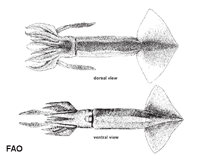
Roper, C.F.E., M.J. Sweeney and C.E. Nauen 1984 FAO Species Catalogue. Vol. 3. Cephalopods of the world. An annotated and illustrated catalogue of species of interest to fisheries. FAO Fish. Synop. 125(3):277p. Rome: FAO. (Referencia 275)
Situación en la Lista Roja de la UICN
(Referencia 130435: Version 2025-2 (Global))
Estatus CITES (Referencia 108899)
Not Evaluated
CMS (Referencia 116361)
Not Evaluated
Amenaza para el ser humano
Usos humanos
Pesquerías: comercial
FAO - pesquerías: landings search; Publication: search | FishSource | Sea Around Us
Herramientas
Más información
FisiologíaConsumo del oxígeno
Relacionados con el ser humanoSellos, monedas, varios
Fuentes de Internet
Estimaciones basadas en modelos
Rate of population increase
|
Prior r = 0.51, 95% CL = 0.34 - 0.76, Based on 1 full stock assessment. |
Vulnerabilidad pesquera
(Referencia 71543) |
Low to moderate vulnerability (34 of 100). |
Vulnerabilidad climática
(Referencia 125649) |
Low vulnerability (7 of 100) |
Categoría de precios
(Referencia 80766): |
Medium. |
Nutrients
|
Calcium = 126 [75, 177] mg/100g; Iron = 4.79 [1.67, 7.92] mg/100g; Protein = 15.5 [13.7, 17.4] %; Omega3 = 0.414 [0.262, 0.566] g/100g; Selenium = 57.8 [48.5, 67.2] μg/100g; VitaminA = 0 μg/100g; Zinc = 1.97 [0.92, 3.02] mg/100g (wet weight); based on nutrient studies. |