Cephalopoda |
Sepiida |
Sepiolidae | Sepiolinae
Ambiente: milieu / zona climática / intervalo de profundidade / gama de distribuição
Ecologia
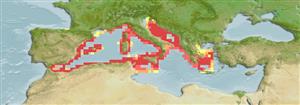
Benthic; intervalo de profundidade 8 - 200 m (Ref. 1695). Subtropical; 46°N - 35°N, 6°W - 26°E (Ref. 1695)
Mediterranean Sea.
Comprimento na primeira maturidade / Tamanho / Peso / Idade
Maturidade: Lm ? range ? - ? cm Max length : 2.6 cm ML macho/indeterminado; (Ref. 1695); 2.8 cm ML (female)
Found mainly on muddy bottoms between 60 and 200 m depth throughout its distributional range. A preference for shallower, coastal and sandy bottoms have been observed in the Adriatic and Tyrrhenian Seas where it can be very abundant and often associated with Turritella communis, Astropecten bispinosus, and Ophiura texturata. Spawning period possibly prolonged based on the observation of mature individuals present throughout the year. Adults have been collected in midwater during night purse seine fishing for blue fishes, evidence of its strong swimming ability. Collected by local small-scale fisheries throughout its distributional range (Ref. 1695).
Ciclo de vida e comportamento de acasalamento
Maturidade | Reprodução | Desova | Ovos | Fecundidade | Larvas
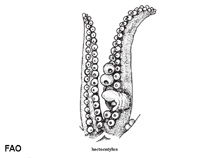
Members of the class Cephalopoda are gonochoric. Male and female adults usually die shortly after spawning and brooding, respectively. Mating behavior: Males perform various displays to attract potential females for copulation. During copulation, male grasp the female and inserts the hectocotylus into the female's mantle cavity where fertilization usually occurs. Life cycle: Embryos hatch into planktonic stage and live for some time before they grow larger and take up a benthic existence as adults.
Jereb, P. and C.F.E. Roper (eds.) 2005 Cephalopods of the world. An Annotated and Illustrated catalogue of Cephalopod species known to date. Vol. 1. Chambered nautiluses and sepioids (Nautilidae, Sepiidae, Sepiolidae, Sepiadariidae, Idiosepiidae and Spirulidae). FAO Spec. Cat. Fish. Purp. 4(1):262p. Rome: FAO. (Ref. 1695)
Categoria na Lista Vermelha da IUCN
(Ref. 130435: Version 2025-2 (Global))
Categoria CITES (Ref. 108899)
Not Evaluated
Not Evaluated
Ameaça para o homem
Utilização humana
FAO - Publication: search | FishSource |
Ferramentas
Mais informação
Ecologia TróficaProdutos alimentares (presas)
Composição da dieta
Consumo alimentar
Predadores
Dinâmica das populaçõesCrescimentoIdades / tamanhos máximosComprimento-peso rel.Comprimento-comprimento rel.Frequência de comprimentoConversão de massaAbundância Ciclo de vidaReproduçãoMaturidadeFecundidadeDesovaOvosDesenvolvimento dos ovosLarvas FisiologiaConsumo de oxigénio
Relacionado com o ser humanoSelos, moedas, diversos.
Fontes da internet
Estimativas baseadas em modelos
Vulnerabilidade da pesca
(Ref. 71543) |
Low vulnerability (10 of 100). |
Categoria de preço
(Ref. 80766): |
Unknown. |