This website uses cookies to enhance your browsing experience and ensure the functionality of our site. For more detailed information about the types of cookies we use and how we protect your privacy, please visit our Privacy Information page..
×
Cookie Settings
This website uses different types of cookies to enhance your experience. Please select your preferences below:
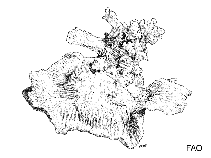
Colony: massive, submassive, or encrusting. Corallites: very meandroid with long valleys, or sub-meandroid with short valleys of 1 to 3 centers. Most with deep, steep sided valleys and distinct corallite centers. Septa: regularly spaced, equal and even; paliform lobes present; margins with fine dentations. Large and conspicuous columella. Thecae thickness varies greatly. Skeletal structures vary between environments. Colors also variable but are mostly uniformly dull brown or green; walls and valley floors occasionally in contrasting colors (Ref. 085244).
Found on rocky and gravel bottom at depths between 1.8 to 21.6 m. Also on volcanic submarine beds (Ref. 88968) and most tropical coral reef environments (Ref. 85244).
Hermaphroditic (Ref. 113712). Mature gametes are shed into the coelenteron and spawned through the mouth. Life cycle: The zygote develops into a planktonic planula larva. Metamorphosis begins with early morphogenesis of tentacles, septa and pharynx before larval settlement on the aboral end (Ref. 833).