Hexacorallia |
Scleractinia |
Merulinidae
Umwelt: Milieu / Klimazone / Tiefenbereich / Verbreitungsgebiet
Ökologie
Riff-verbunden; tiefenbereich 0 - 40 m (Ref. 848). Tropical; 36°N - 37°S, 32°E - 108°W (Ref. 848)
Indo-Pacific and Southwest Atlantic.
Länge bei der ersten Reifung / Größe / Gewicht / Alter
Geschlechtsreife: Lm ? range ? - ? cm
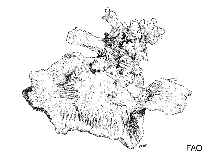
Colony: massive, submassive, or encrusting. Corallites: very meandroid with long valleys, or sub-meandroid with short valleys of 1 to 3 centers. Most with deep, steep sided valleys and distinct corallite centers. Septa: regularly spaced, equal and even; paliform lobes present; margins with fine dentations. Large and conspicuous columella. Thecae thickness varies greatly. Skeletal structures vary between environments. Colors also variable but are mostly uniformly dull brown or green; walls and valley floors occasionally in contrasting colors (Ref. 085244).
Found on rocky and gravel bottom at depths between 1.8 to 21.6 m. Also on volcanic submarine beds (Ref. 88968) and most tropical coral reef environments (Ref. 85244).
Lebenszyklus und Paarungsverhalten
Geschlechtsreife | Fortpflanzung | Ablaichen | Eier | Fruchtbarkeit | Larven
Hermaphroditic (Ref. 113712). Mature gametes are shed into the coelenteron and spawned through the mouth. Life cycle: The zygote develops into a planktonic planula larva. Metamorphosis begins with early morphogenesis of tentacles, septa and pharynx before larval settlement on the aboral end (Ref. 833).
Veron, J.E.N. 2000 Corals of the world. Volume 3. Australian Institute of Marine Science and CRR Qld. Pty. Ltd. Australia. 490 p. (Ref. 848)
IUCN Rote Liste Status
(Ref. 130435: Version 2025-2 (Global))
CITES Status (Ref. 108899)
Not Evaluated
Bedrohung für Menschen
Nutzung durch Menschen
FAO - Publication: search | FishSource |
Tools
Mehr Information
Trophische ÖkologieLebensmittel (Beutetiere)
Nahrungszusammensetzung
Nahrungsaufnahme
Räuber
PopulationsdynamikWachstumMax. Alter/GrößenLänge-Gewicht-Rel.Länge-Länge-Verhältnis.LängenhäufigkeitenMassenkonvertierungDichte PhysiologieSauerstoffverbrauch
MenschenbezogenBriefmarken, Münzen, Verschiedenes.
Internet Quellen
Schätzungen auf der Grundlage von Modellen
Anfälligkeit der Fischerei
(Ref. 71543) |
(0 of 100). |
Preiskategorie
(Ref. 80766): |
Unknown. |