Malacostraca |
Decapoda |
Astacidae
Umwelt: Milieu / Klimazone / Tiefenbereich / Verbreitungsgebiet
Ökologie
Benthic; süßwasser. Temperate
Europe inland waters: northern and eastern Europe, including portions of France eastward to countries of the Russian Commonwealth and southern Scandinavia southward. Absent from the Italian and Balkan Peninsulas. Introduced to various parts of Europe, Western Asia and North Africa.
Länge bei der ersten Reifung / Größe / Gewicht / Alter
Geschlechtsreife: Lm ? range ? - ? cm Max length : 25.0 cm TL Männchen/unbestimmt; (Ref. 127977)
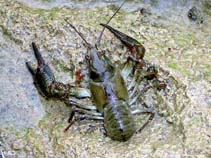
Typically brown or green on the back, underside of first pair of claws dark red or reddish brown.
First crayfish species to be described in 1758; important species in European fisheries for centuries. Occurs in a wide variety of habitats, from streams and rivers to lakes, usually in well-oxygenated waters with sufficient foliage cover. An opportunistic feeder on living and dead plant and animal matter. Mating usually in autumn, eggs are carried over winter and hatching occurs in spring and summer. Most native European populations were decimated by the crayfish plague, first detected in Italy in the 1860s. Introduced North American spinycheek crayfish, Orconectes limosus (to replace stocks of decimated population of noble crayfish in the Oder River, Germany in 1890) and other introduced crayfish species competing with and displacing native noble crayfish populations coupled with habitat destruction and pollution contributed to the decline in noble crayfish populations in Europe. Protected under the European Union Habitats Directive (Ref. 80793). Occurs in a wide variety of habitats, from streams and rivers to lakes, usually in well-oxygenated waters with sufficient foliage cover (daytime retreat under rocky or woody debris and dense foliage); also burrows on stream banks. An opportunistic feeder on living and dead plant and animal matter. Living aquatic insects, crustaceans, worms, sponges, bryozoans and mollusks are preferred with the crayfish crushing prey with their lower jaws. Birds, mammals and fish prey on the noble crayfish (Ref. 80788).
Lebenszyklus und Paarungsverhalten
Geschlechtsreife | Fortpflanzung | Ablaichen | Eier | Fruchtbarkeit | Larven
Hildyard, A. and M. Cavendish 2001 Endangered Wildlife and Plants of the World. Marshall Cavendish Corporation, NY, USA. 1872 p. (Ref. 80788)
IUCN Rote Liste Status
(Ref. 130435: Version 2025-2 (Global))
CITES Status (Ref. 108899)
Not Evaluated
Not Evaluated
Bedrohung für Menschen
Harmless
Nutzung durch Menschen
Fischereien: kommerziell; Aquakultur: experimental
FAO - Aquaculture Systems: production searchFischereien: landings search; Publication: search | FishSource | Das Meer um uns herum
Tools
Mehr Information
PhysiologieSauerstoffverbrauch
MenschenbezogenBriefmarken, Münzen, Verschiedenes.
Internet Quellen
Schätzungen auf der Grundlage von Modellen
Anfälligkeit der Fischerei
(Ref. 71543) |
Low vulnerability (15 of 100). |
Preiskategorie
(Ref. 80766): |
Unknown. |