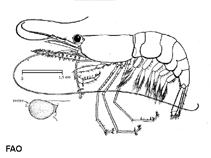
Malacostraca |
Decapoda |
Processidae
สิ่งแวดล้อม : สิ่งแวดล้อม / เขตภูมิอากาศ / ระดับความลึก / ระยะการกระจายสินค้า
นิเวศวิทยา
Benthic; กร่อย; ระดับความลึก 10 - 871 m (อ้างอิง 80197), usually 200 - 400 m (อ้างอิง 78235). Temperate; 63°N - 27°N, 18°W - 36°E
Eastern Atlantic and the Mediterranean: from British Isles down to Atlantic Morocco, and western Mediterranean.
ความยาวเมื่อครบกำหนดครั้งแรก / ขนาด / น้ำหนัก / อายุ
วัยเจริญพันธุ์: Lm ? range ? - ? cm Max length : 6.7 cm TL เพศผู้/กระเทย; (อ้างอิง 104052); 7.5 cm TL (female)
Minimum depth from Ref. 105475. Endobenthic - burrower and burier (Refs. 105216, 105217). Littoral to sublittoral (Ref. 105219). Inhabits the subtidal region, in soft bottoms of fine to medium-grained sand (Ref. 96507). Found in coarse clean sand, gravelly sand (Ref. 105219) and muddy bottoms (Ref. 105216). Also occurs in areas influenced by estuarine outflows (Ref. 96507). Solitary (Ref. 105219). Active predator (Ref. 105216). Feeds on small polychaetes and sipunculids (Refs. 105216, 105219).
วงจรชีวิตและพฤติกรรมการผสมพันธุ์
วัยเจริญพันธุ์ | การสืบพันธุ์ | การวางไข่ | เซลสืบพันธ์ของเพศเมีย(ไข่) | ความดกของไข่ | ตัวอ่อน
Members of the order Decapoda are mostly gonochoric. Mating behavior: Precopulatory courtship ritual is common (through olfactory and tactile cues); usually indirect sperm transfer.
Jennings, S., J. Lancaster, A. Woolmer and J. Cotter 1999 Distribution, diversity and abundance of epibenthic fauna in the North Sea. Journal of the Marine Biological Association of the UK 79:385-399. (อ้างอิง 3123)
สถานะบัญชีแดงของ IUCN
(อ้างอิง 130435: Version 2025-2 (Global))
สถานะไซเตส (อ้างอิง 108899)
Not Evaluated
CMS (อ้างอิง 116361)
Not Evaluated
ภัยคุกคามต่อมนุษย์
การใช้ของมนุษย์
การประมง: การค้า
FAO - Publication: search | FishSource |
เครื่องมือ
ข้อมูลเพิ่มเติม
วงจรชีวิตการสืบพันธุ์วัยเจริญพันธุ์ความดกของไข่การวางไข่เซลสืบพันธ์ของเพศเมีย(ไข่)การพัฒนาไข่ตัวอ่อน เกี่ยวข้องกับมนุษย์แสตมป์ เหรียญ อื่นๆ
แหล่งที่มาจากอินเตอร์เน็ต
การประมาณค่าตามแบบจำลอง
ความสามารถในการกลับคืนสู่ปกติ
(Ref. 69278): |
ความสูง, เวลาต่ำสุดที่จะทำให้ประชากรเพิ่มขึ้นเป็น 2 เท่าใช้เวลาน้อยกว่า 15 เดือน (K=0.7-1.1) |
ความเสี่ยงต่อการตกปลา
(อ้างอิง 71543) |
Low vulnerability (10 of 100). |
หมวดหมู่ราคา
(อ้างอิง 80766): |
Unknown. |