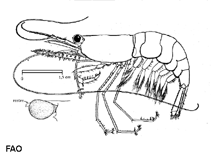
Malacostraca |
Decapoda |
Processidae
Umwelt: Milieu / Klimazone / Tiefenbereich / Verbreitungsgebiet
Ökologie
Benthic; brackwasser; tiefenbereich 10 - 871 m (Ref. 80197), usually 200 - 400 m (Ref. 78235). Temperate; 63°N - 27°N, 18°W - 36°E
Eastern Atlantic and the Mediterranean: from British Isles down to Atlantic Morocco, and western Mediterranean.
Länge bei der ersten Reifung / Größe / Gewicht / Alter
Geschlechtsreife: Lm ? range ? - ? cm Max length : 6.7 cm TL Männchen/unbestimmt; (Ref. 104052); 7.5 cm TL (female)
Minimum depth from Ref. 105475. Endobenthic - burrower and burier (Refs. 105216, 105217). Littoral to sublittoral (Ref. 105219). Inhabits the subtidal region, in soft bottoms of fine to medium-grained sand (Ref. 96507). Found in coarse clean sand, gravelly sand (Ref. 105219) and muddy bottoms (Ref. 105216). Also occurs in areas influenced by estuarine outflows (Ref. 96507). Solitary (Ref. 105219). Active predator (Ref. 105216). Feeds on small polychaetes and sipunculids (Refs. 105216, 105219).
Lebenszyklus und Paarungsverhalten
Geschlechtsreife | Fortpflanzung | Ablaichen | Eier | Fruchtbarkeit | Larven
Members of the order Decapoda are mostly gonochoric. Mating behavior: Precopulatory courtship ritual is common (through olfactory and tactile cues); usually indirect sperm transfer.
Jennings, S., J. Lancaster, A. Woolmer and J. Cotter 1999 Distribution, diversity and abundance of epibenthic fauna in the North Sea. Journal of the Marine Biological Association of the UK 79:385-399. (Ref. 3123)
IUCN Rote Liste Status
(Ref. 130435: Version 2025-2 (Global))
CITES Status (Ref. 108899)
Not Evaluated
Not Evaluated
Bedrohung für Menschen
Nutzung durch Menschen
Fischereien: kommerziell
FAO - Publication: search | FishSource |
Tools
Mehr Information
LebenszyklusFortpflanzungGeschlechtsreifeFruchtbarkeitAblaichenEierEientwicklungLarven MenschenbezogenBriefmarken, Münzen, Verschiedenes.
Internet Quellen
Schätzungen auf der Grundlage von Modellen
Widerstandsfähigkeit
(Ref. 69278): |
hoch, Verdopplung der Population dauert weniger als 15 Monate. (K=0.7-1.1) |
Anfälligkeit der Fischerei
(Ref. 71543) |
Low vulnerability (10 of 100). |
Preiskategorie
(Ref. 80766): |
Unknown. |