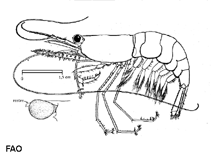
Malacostraca |
Decapoda |
Processidae
Environnement : milieu / zone climatique / profondeur / gamme de distribution
Écologie
Benthic; saumâtre; profondeur 10 - 871 m (Réf. 80197), usually 200 - 400 m (Réf. 78235). Temperate; 63°N - 27°N, 18°W - 36°E
Eastern Atlantic and the Mediterranean: from British Isles down to Atlantic Morocco, and western Mediterranean.
Longueur à la première maturité / Taille / Poids / Âge
Maturité: Lm ? range ? - ? cm Max length : 6.7 cm TL mâle / non sexé; (Réf. 104052); 7.5 cm TL (female)
Minimum depth from Ref. 105475. Endobenthic - burrower and burier (Refs. 105216, 105217). Littoral to sublittoral (Ref. 105219). Inhabits the subtidal region, in soft bottoms of fine to medium-grained sand (Ref. 96507). Found in coarse clean sand, gravelly sand (Ref. 105219) and muddy bottoms (Ref. 105216). Also occurs in areas influenced by estuarine outflows (Ref. 96507). Solitary (Ref. 105219). Active predator (Ref. 105216). Feeds on small polychaetes and sipunculids (Refs. 105216, 105219).
Cycle de vie et comportement reproducteur
Maturité | Reproduction | Frai | Œufs | Fécondité | Larves
Members of the order Decapoda are mostly gonochoric. Mating behavior: Precopulatory courtship ritual is common (through olfactory and tactile cues); usually indirect sperm transfer.
Jennings, S., J. Lancaster, A. Woolmer and J. Cotter 1999 Distribution, diversity and abundance of epibenthic fauna in the North Sea. Journal of the Marine Biological Association of the UK 79:385-399. (Réf. 3123)
Statut dans la liste rouge de l'IUCN
(Réf. 130435: Version 2025-2 (Global))
statut CITES (Réf. 108899)
Not Evaluated
Not Evaluated
Menace pour l'homme
Utilisations par l'homme
Pêcheries: commercial
FAO - Publication: search | FishSource |
Outils
Plus d'informations
Dynamique des populations Cycle de vieReproductionMaturitéFéconditéFraiŒufsDéveloppement de l'œufLarves Liées à l'hommeTimbres, pièces de monnaie, divers
Sources Internet
Estimations basées sur des modèles
Résilience
(Ref. 69278): |
Haut, temps minimum de doublement de population inférieur à 15 mois (K=0.7-1.1) |
Vulnérabilité de la pêche
(Réf. 71543) |
Low vulnerability (10 of 100). |
Catégorie de prix
(Réf. 80766): |
Unknown. |