Malacostraca |
Decapoda |
Palaemonidae
Ambiente: milieu / zona climática / intervalo de profundidade / gama de distribuição
Ecologia
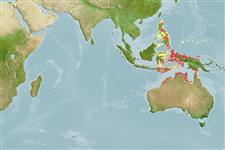
Benthic; Água doce; estuarina; intervalo de profundidade 0 - 2 m (Ref. 97531). Tropical; 21°N - 18°S, 116°E - 151°E (Ref. 110598)
Indo-Pacific: M. rosenbergii actually are two separate species; M. rosenbergii is distributed East of Huxley's Line from the Philippines (including Palawan), Lesser Sunda Islands, New Guinea and northern Australia and M. dacqueti ranges from Pakistan, India, Sri Lanka to the Asian mainland in southern China, Taiwan and up to Malaysia, Borneo and Java.
Comprimento na primeira maturidade / Tamanho / Peso / Idade
Maturidade: Lm ? range ? - ? cm Max length : 34.0 cm TL macho/indeterminado; (Ref. 104052); 26 cm TL (female)
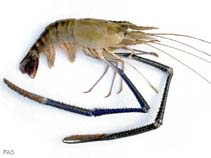
Wild post larvae migrate to down-stream near to the sea to a higher elevation freshwater waters streams (Ref. 82055). The native range of Macrobrachium rosenbergii actually consists of two separate species differing in adult morphological features. The actual M. rosenbergii occurs in northern Australia, Papua New Guinea, eastern Indonesia (east of Huxley's line including Bali) and the Philippines (includes Palawan). The second species is discovered as M. dacqueti (Sunier, 1925) which is actually the species extensively commercially fished and cultured. This species occurs in Asian mainland from Pakistan, India, Sri Lanka and southern China and to the western border of Huxley's line excluding Palawan, up to Borneo and Java (Ref. 110598, 110593). Coastal freshwater and estuarine (Ref. 97531), found in a mangrove (Ref. 121467). Survival rate and growth high at 0-15 ppt (Ref. 111574).
Ciclo de vida e comportamento de acasalamento
Maturidade | Reprodução | Desova | Ovos | Fecundidade | Larvas
Members of the order Decapoda are mostly gonochoric. Mating behavior: Precopulatory courtship ritual is common (through olfactory and tactile cues); usually indirect sperm transfer.
del Mundo, C.M. 2000 Philippine decapod crustacea. An illustrated handbook on the commercially important decapod crustacea of the Philippines. Fisheries Resources Evaluation and Environmental Services Division, Bureau of Fisheries and Aquatic Resources. Quezon City, Philippines. 83 p. (Ref. 10)
Categoria na Lista Vermelha da IUCN
(Ref. 130435: Version 2025-2 (Global))
Categoria CITES (Ref. 108899)
Not Evaluated
Not Evaluated
Ameaça para o homem
Utilização humana
Pescarias: espécies comerciais
FAO - Aquaculture Systems: perfil da espécie, production search; pescarias: perfil da espécie, landings search; Publication: search | FishSource | Sea Around Us
Ferramentas
Mais informação
Ecologia TróficaProdutos alimentares (presas)
Composição da dieta
Consumo alimentar
Predadores
Ciclo de vidaReproduçãoMaturidadeFecundidadeDesovaOvosDesenvolvimento dos ovosLarvas FisiologiaConsumo de oxigénio
Relacionado com o ser humanoSelos, moedas, diversos.
Fontes da internet
Estimativas baseadas em modelos
Vulnerabilidade da pesca
(Ref. 71543) |
Low vulnerability (24 of 100). |
Categoria de preço
(Ref. 80766): |
Very high. |