Malacostraca |
Decapoda |
Palaemonidae
Environnement : milieu / zone climatique / profondeur / gamme de distribution
Écologie
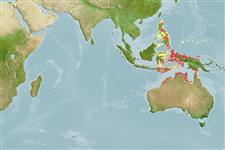
Benthic; eau douce; saumâtre; profondeur 0 - 2 m (Réf. 97531). Tropical; 21°N - 18°S, 116°E - 151°E (Réf. 110598)
Indo-Pacific: M. rosenbergii actually are two separate species; M. rosenbergii is distributed East of Huxley's Line from the Philippines (including Palawan), Lesser Sunda Islands, New Guinea and northern Australia and M. dacqueti ranges from Pakistan, India, Sri Lanka to the Asian mainland in southern China, Taiwan and up to Malaysia, Borneo and Java.
Longueur à la première maturité / Taille / Poids / Âge
Maturité: Lm ? range ? - ? cm Max length : 34.0 cm TL mâle / non sexé; (Réf. 104052); 26 cm TL (female)
Wild post larvae migrate to down-stream near to the sea to a higher elevation freshwater waters streams (Ref. 82055). The native range of Macrobrachium rosenbergii actually consists of two separate species differing in adult morphological features. The actual M. rosenbergii occurs in northern Australia, Papua New Guinea, eastern Indonesia (east of Huxley's line including Bali) and the Philippines (includes Palawan). The second species is discovered as M. dacqueti (Sunier, 1925) which is actually the species extensively commercially fished and cultured. This species occurs in Asian mainland from Pakistan, India, Sri Lanka and southern China and to the western border of Huxley's line excluding Palawan, up to Borneo and Java (Ref. 110598, 110593). Coastal freshwater and estuarine (Ref. 97531), found in a mangrove (Ref. 121467). Survival rate and growth high at 0-15 ppt (Ref. 111574).
Cycle de vie et comportement reproducteur
Maturité | Reproduction | Frai | Œufs | Fécondité | Larves
Members of the order Decapoda are mostly gonochoric. Mating behavior: Precopulatory courtship ritual is common (through olfactory and tactile cues); usually indirect sperm transfer.
del Mundo, C.M. 2000 Philippine decapod crustacea. An illustrated handbook on the commercially important decapod crustacea of the Philippines. Fisheries Resources Evaluation and Environmental Services Division, Bureau of Fisheries and Aquatic Resources. Quezon City, Philippines. 83 p. (Réf. 10)
Statut dans la liste rouge de l'IUCN
(Réf. 130435: Version 2025-2 (Global))
statut CITES (Réf. 108899)
Not Evaluated
Not Evaluated
Menace pour l'homme
Utilisations par l'homme
Pêcheries: commercial
FAO - Aquaculture Systems: Résumé espèce, production search; pêcheries: Résumé espèce, landings search; Publication: search | FishSource | Sea Around Us
Outils
Plus d'informations
Écologie trophiqueAliments (proies)
Composition du régime alimentaire
Consommation alimentaire
Prédateurs
Dynamique des populations Cycle de vieReproductionMaturitéFéconditéFraiŒufsDéveloppement de l'œufLarves PhysiologieConsommation d'oxygène
Liées à l'hommeTimbres, pièces de monnaie, divers
Sources Internet
Estimations basées sur des modèles
Vulnérabilité de la pêche
(Réf. 71543) |
Low vulnerability (24 of 100). |
Catégorie de prix
(Réf. 80766): |
Very high. |