Malacostraca |
Decapoda |
Scyllaridae
Entorno: milieu / zona climática / rango de profundidad / gama de distribución
Ecología
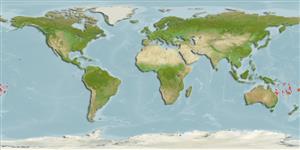
Benthic; rango de profundidad 0 - 20 m (Referencia 101290). Tropical; 9°S - 26°S, 150°E - 169°W (Referencia 4)
Distribución
Territories | Áreas FAO | Ecosistemas | Ocurrencias, apariciones | Introducciones
Central Pacific: from Queensland, Australia to Samoa.
Longitud en la primera madurez / Tamaño / Peso / Edad
Madurez: Lm ? range ? - ? cm Max length : 18.0 cm BL macho / no sexado; (Referencia 4)
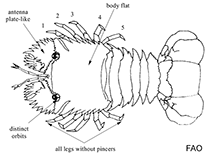
It has lengths of 18 cm, maximum total body length; between 4.5 and 8 cm, carapace length (Ref. 4). Minimum depth range from Ref. 122059. It is found in shallow water on reefs, usually on the exposed side, often in surge channels. They hide in crevices and marine caves in the day time, often attached to the ceilings of the caves (Ref. 4). In general, scyllarids are mainly carnivorous scavengers preferring small benthic invertebrates (Ref. 106995). Its congener Parribacus antarcticus appears to be an invertebrate generalist while other scyllarids are observed to become specialized for feeding on bivalves (Ref. 106996).
Ciclo vital y comportamiento de apareamiento
Madurez | Reproducción | Puesta | Huevos | Fecundidad | Larva
Members of the order Decapoda are mostly gonochoric. Mating behavior: Precopulatory courtship ritual is common (through olfactory and tactile cues); usually indirect sperm transfer.
Holthuis, L.B. 1991 FAO Species Catalogue. Vol. 13. Marine lobsters of the world. An annotated and illustrated catalogue of species of interest to fisheries known to date. FAO Fish. Synop. 125(13):292p. Rome: FAO. (Referencia 4)
Situación en la Lista Roja de la UICN
(Referencia 130435: Version 2025-2 (Global))
Estatus CITES (Referencia 108899)
Not Evaluated
CMS (Referencia 116361)
Not Evaluated
Amenaza para el ser humano
Usos humanos
Pesquerías: comercial
FAO - Publication: search | FishSource | Sea Around Us
Herramientas
Más información
Ecología TróficaAlimentos (presas)
Composición de la dieta
consumo de alimento
Despredadores
Dinámica de la poblaciónCrecimientoEdades / tallas máximasLongitud-peso rel.Longitud-longitud rel.Longitud-frecuenciasConversión de masasAbundancia FisiologíaConsumo del oxígeno
Relacionados con el ser humanoSellos, monedas, varios
Fuentes de Internet
Estimaciones basadas en modelos
Vulnerabilidad pesquera
(Referencia 71543) |
Low vulnerability (10 of 100). |
Categoría de precios
(Referencia 80766): |
Very high. |
Nutrients
|
Calcium = 109 [35, 184] mg/100g; Iron = 1.59 [1.21, 1.97] mg/100g; Protein = 20.2 [19.2, 21.3] %; Omega3 = 0.285 [0.185, 0.386] g/100g; Selenium = 48.3 [-31.7, 128.3] μg/100g; VitaminA = 0 μg/100g; Zinc = 1.79 [1.17, 2.40] mg/100g (wet weight); based on nutrient studies. |