Malacostraca |
Decapoda |
Scyllaridae
Ambiente: milieu / zona climatica / distribuzione batimetrica / gamma di distribuzione
Ecologia
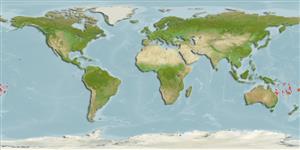
Benthic; distribuzione batimetrica 0 - 20 m (Fonte Biblio. 101290). Tropical; 9°S - 26°S, 150°E - 169°W (Fonte Biblio. 4)
Central Pacific: from Queensland, Australia to Samoa.
Lunghezza alla prima maturità / Dimensione / Peso / Età
Maturità: Lm ? range ? - ? cm Max length : 18.0 cm BL maschio/sesso non determinato; (Fonte Biblio. 4)
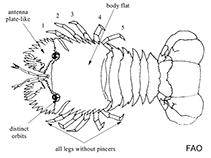
It has lengths of 18 cm, maximum total body length; between 4.5 and 8 cm, carapace length (Ref. 4). Minimum depth range from Ref. 122059. It is found in shallow water on reefs, usually on the exposed side, often in surge channels. They hide in crevices and marine caves in the day time, often attached to the ceilings of the caves (Ref. 4). In general, scyllarids are mainly carnivorous scavengers preferring small benthic invertebrates (Ref. 106995). Its congener Parribacus antarcticus appears to be an invertebrate generalist while other scyllarids are observed to become specialized for feeding on bivalves (Ref. 106996).
Ciclo vitale e comportamento di accoppiamento
Maturità | Riproduzione | Deposizione | Uova | Fecondità | Larve
Members of the order Decapoda are mostly gonochoric. Mating behavior: Precopulatory courtship ritual is common (through olfactory and tactile cues); usually indirect sperm transfer.
Holthuis, L.B. 1991 FAO Species Catalogue. Vol. 13. Marine lobsters of the world. An annotated and illustrated catalogue of species of interest to fisheries known to date. FAO Fish. Synop. 125(13):292p. Rome: FAO. (Fonte Biblio. 4)
Stato della Lista Rossa IUCN
(Fonte Biblio. 130435: Version 2025-2 (Global))
Stato della CITES (Fonte Biblio. 108899)
Not Evaluated
CMS (Fonte Biblio. 116361)
Not Evaluated
Minaccia per l'uomo
Usi umani
Pesca: commerciale
FAO - Publication: search | FishSource | Sea Around Us
Strumenti
Informazioni ulteriori
Ecologia troficaArticoli alimentari (prede)
Alimentazione
Consumo di cibo
Predatori
Dinamica della popolazioneAccrescimentoEtà massima / dimensioni massimeRapporto lunghezza-peso.Lunghezza-lunghezza rel.Lunghezza-frequenzeConversione di massaAbbondanza FisiologiaConsumo di ossigeno
Legato all'uomoFrancobolli, monete, materiale vario.
Fonti Internet
Stime basate su modelli
Vulnerabilità della pesca
(Fonte Biblio. 71543) |
Low vulnerability (10 of 100). |
Categoria di prezzo
(Fonte Biblio. 80766): |
Very high. |
Nutrients
|
Calcium = 109 [35, 184] mg/100g; Iron = 1.59 [1.21, 1.97] mg/100g; Protein = 20.2 [19.2, 21.3] %; Omega3 = 0.285 [0.185, 0.386] g/100g; Selenium = 48.3 [-31.7, 128.3] μg/100g; VitaminA = 0 μg/100g; Zinc = 1.79 [1.17, 2.40] mg/100g (wet weight); based on nutrient studies. |