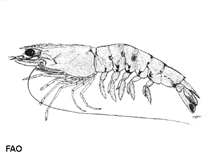
Malacostraca |
Decapoda |
Penaeidae
Umwelt: Milieu / Klimazone / Tiefenbereich / Verbreitungsgebiet
Ökologie
Benthic; tiefenbereich 0 - 80 m (Ref. 8). Tropical, preferred 25°C (Ref. 107945); 36°N - 36°S, 32°E - 178°W
Indo-West Pacific: from Gulf of Suez, Egypt and Kuwait, and Mozambique, north to Tokyo Bay, Japan, south to Gulf of St. Vincent, Australia, east to New Caledonia and Fiji. Introduced on the Mediterranean coast of Egypt.
Länge bei der ersten Reifung / Größe / Gewicht / Alter
Geschlechtsreife: Lm ? range ? - ? cm Max length : 20.0 cm TL Männchen/unbestimmt; (Ref. 119750); 22 cm TL (female); max. veröff. Gewicht: 60.00 g (Ref. 116487)
Intertidal (Ref. 374) to subtidal (Ref. 106854'>106854). Juveniles are found on seagrass beds and mangroves higher in the shoreline (Ref. 106908'>106908). Inhabits open sea areas with sandy or muddy and sandy bottom (Ref. 374). Nocturnal (Refs. 10, 85270). Burrows on sand at daytime (Ref. 801).
Life cycle: pelagic larvae (four larval stages: nauplii, zoea, mysis and post-larvae) to inshore juvenile to offshore adult (Ref. 107331). Mating behavior: Precopulatory courtship ritual is common (through olfactory and tactile cues); usually indirect sperm transfer (Ref. 833). The male transfers its spermatophore to the female's thelycum (Ref. 107331).
Holthuis, L.B. 1980 FAO Species Catalogue. Vol. 1. Shrimps and prawns of the world. An annotated catalogue of species of interest to fisheries. FAO Fish. Synop. 125(1):271 p. Rome: FAO. (Ref. 8)
IUCN Rote Liste Status
(Ref. 130435: Version 2025-2 (Global))
CITES Status (Ref. 108899)
Not Evaluated
Not Evaluated
Bedrohung für Menschen
Nutzung durch Menschen
Fischereien: kommerziell
FAO - Fischereien: landings search; Publication: search | FishSource | Das Meer um uns herum
Tools
Mehr Information
Trophische ÖkologieLebensmittel (Beutetiere)NahrungszusammensetzungNahrungsaufnahmeRäuber PhysiologieSauerstoffverbrauch
MenschenbezogenBriefmarken, Münzen, Verschiedenes.
Internet Quellen
Schätzungen auf der Grundlage von Modellen
Widerstandsfähigkeit
(Ref. 69278): |
hoch, Verdopplung der Population dauert weniger als 15 Monate. (K=0.36-1.9) |
Rate of population increase
|
Prior r = 1.12, 95% CL = 0.74 - 1.69, Based on 4 data-limited stock assessments. |
Anfälligkeit der Fischerei
(Ref. 71543) |
Low vulnerability (11 of 100). |
Klimaanfälligkeit
(Ref. 125649) |
Low to moderate vulnerability (34 of 100) |
Preiskategorie
(Ref. 80766): |
Very high. |
Nutrients
|
Calcium = 109 [35, 184] mg/100g; Iron = 1.59 [1.21, 1.97] mg/100g; Protein = 20.2 [19.2, 21.3] %; Omega3 = 0.285 [0.185, 0.386] g/100g; Selenium = 48.3 [-31.7, 128.3] μg/100g; VitaminA = 0 μg/100g; Zinc = 1.79 [1.17, 2.40] mg/100g (wet weight); based on nutrient studies. |