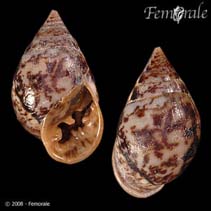
Gastropoda |
Ellobiida |
Ellobiidae
Môi trường: môi trường / vùng khí hậu / Mức độ sâu / phạm vi phân phối
Sinh thái học
Benthic. Tropical
Indo-Pacific.
Chiều dài lúc trưởng thành đầu tiên / Bộ gần gũi / Khối lượng (Trọng lượng) / Tuổi
Chín muồi sinh dục: Lm ? range ? - ? cm Max length : 3.5 cm SHL con đực/không giới tính; (Tài liệu tham khảo 349); common length : 3.0 cm SHL con đực/không giới tính; (Tài liệu tham khảo 349)
Common on coastal environments, especially near forests (Ref. 349).
Vòng đời và hành vi giao phối
Chín muồi sinh dục | Sự tái sinh sản | Đẻ trứng | Các trứng | Sự sinh sản | Ấu trùng
Simultaneous hermaphrodites (Ref. 833). Development: single eggs into oval capsules of 0.2 mm length, which are interconnected by chalazae to form a more or less spiral chain; the capsules are contained in a sac-like gelatinous mass of 1 mm length; the gastrula stage is reached after 3-4 days of development; two days later the initial shell cap has been secreted, which subsequently increases rapidly in size; the velum shows a single disc-like lobe, which, however, exhibits two ciliary rings foreshadowing the bilobed condition of the newly hatched veliger; the foot has secreted an operculum and holds two statoliths within the corresponding cysts; during the eighth day of the embryogeny shell and operculum become functional to house the embryo and seal the aperture respectively; three days later veligers hatch out, which have no eyes, no mantle cavity and only the anlage of a heart (Ref. 99946).
Poutiers, J.M. 1998 Gastropods. p. 363-648. In Carpenter, K. E. and V. H. Niem. 1998. FAO species identification guide for fishery purposes. The living marine resources of the Western Central Pacific. Volume 1. Seaweeds, corals, bivalves, and gastropods. Rome, FAO. (Tài liệu tham khảo 349)
Tình trạng Sách đỏ IUCN
(Tài liệu tham khảo 130435: Version 2025-2 (Global))
tình trạng CITES (Tài liệu tham khảo 108899)
Not Evaluated
CMS (Tài liệu tham khảo 116361)
Not Evaluated
Mối đe dọa đối với con người
Sử dụng của con người
FAO - Publication: search | FishSource |
Các công cụ
Thêm thông tin
Sinh thái dinh dưỡngThức ăn (con mồi)
Thành phần thức ăn
Thành phần thức ăn
Các động vật ăn mồi
Biến động dân sốSự sinh trưởngĐộ tuổi / kích thước tối đaChiều dài-trọng lượng tương đốiChiều dài-chiều dài tương đối.Chiều dài-tần sốChuyển đổi khối lượngSự phong phú Sinh lý họcThành phần ô-xy
Liên quan đến con ngườiTem, tiền xu, v.v.
Các nguồn internet
Ước tính dựa trên mô hình
Sự dễ bị tổn thương của nghề đánh cá
(Tài liệu tham khảo 71543) |
Low vulnerability (10 of 100). |
Loại giá
(Tài liệu tham khảo 80766): |
Unknown. |