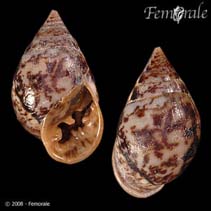
Gastropoda |
Ellobiida |
Ellobiidae
Umwelt: Milieu / Klimazone / Tiefenbereich / Verbreitungsgebiet
Ökologie
Benthic. Tropical
Indo-Pacific.
Länge bei der ersten Reifung / Größe / Gewicht / Alter
Geschlechtsreife: Lm ? range ? - ? cm Max length : 3.5 cm SHL Männchen/unbestimmt; (Ref. 349); common length : 3.0 cm SHL Männchen/unbestimmt; (Ref. 349)
Common on coastal environments, especially near forests (Ref. 349).
Lebenszyklus und Paarungsverhalten
Geschlechtsreife | Fortpflanzung | Ablaichen | Eier | Fruchtbarkeit | Larven
Simultaneous hermaphrodites (Ref. 833). Development: single eggs into oval capsules of 0.2 mm length, which are interconnected by chalazae to form a more or less spiral chain; the capsules are contained in a sac-like gelatinous mass of 1 mm length; the gastrula stage is reached after 3-4 days of development; two days later the initial shell cap has been secreted, which subsequently increases rapidly in size; the velum shows a single disc-like lobe, which, however, exhibits two ciliary rings foreshadowing the bilobed condition of the newly hatched veliger; the foot has secreted an operculum and holds two statoliths within the corresponding cysts; during the eighth day of the embryogeny shell and operculum become functional to house the embryo and seal the aperture respectively; three days later veligers hatch out, which have no eyes, no mantle cavity and only the anlage of a heart (Ref. 99946).
Poutiers, J.M. 1998 Gastropods. p. 363-648. In Carpenter, K. E. and V. H. Niem. 1998. FAO species identification guide for fishery purposes. The living marine resources of the Western Central Pacific. Volume 1. Seaweeds, corals, bivalves, and gastropods. Rome, FAO. (Ref. 349)
IUCN Rote Liste Status
(Ref. 130435: Version 2025-2 (Global))
CITES Status (Ref. 108899)
Not Evaluated
Not Evaluated
Bedrohung für Menschen
Nutzung durch Menschen
FAO - Publication: search | FishSource |
Tools
Mehr Information
Trophische ÖkologieLebensmittel (Beutetiere)
Nahrungszusammensetzung
Nahrungsaufnahme
Räuber
PopulationsdynamikWachstumMax. Alter/GrößenLänge-Gewicht-Rel.Länge-Länge-Verhältnis.LängenhäufigkeitenMassenkonvertierungDichte PhysiologieSauerstoffverbrauch
MenschenbezogenBriefmarken, Münzen, Verschiedenes.
Internet Quellen
Schätzungen auf der Grundlage von Modellen
Anfälligkeit der Fischerei
(Ref. 71543) |
Low vulnerability (10 of 100). |
Preiskategorie
(Ref. 80766): |
Unknown. |