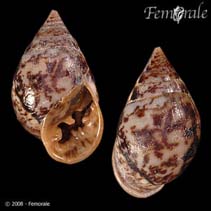
Gastropoda |
Ellobiida |
Ellobiidae
Environnement : milieu / zone climatique / profondeur / gamme de distribution
Écologie
Benthic. Tropical
Indo-Pacific.
Longueur à la première maturité / Taille / Poids / Âge
Maturité: Lm ? range ? - ? cm Max length : 3.5 cm SHL mâle / non sexé; (Réf. 349); common length : 3.0 cm SHL mâle / non sexé; (Réf. 349)
Common on coastal environments, especially near forests (Ref. 349).
Cycle de vie et comportement reproducteur
Maturité | Reproduction | Frai | Œufs | Fécondité | Larves
Simultaneous hermaphrodites (Ref. 833). Development: single eggs into oval capsules of 0.2 mm length, which are interconnected by chalazae to form a more or less spiral chain; the capsules are contained in a sac-like gelatinous mass of 1 mm length; the gastrula stage is reached after 3-4 days of development; two days later the initial shell cap has been secreted, which subsequently increases rapidly in size; the velum shows a single disc-like lobe, which, however, exhibits two ciliary rings foreshadowing the bilobed condition of the newly hatched veliger; the foot has secreted an operculum and holds two statoliths within the corresponding cysts; during the eighth day of the embryogeny shell and operculum become functional to house the embryo and seal the aperture respectively; three days later veligers hatch out, which have no eyes, no mantle cavity and only the anlage of a heart (Ref. 99946).
Poutiers, J.M. 1998 Gastropods. p. 363-648. In Carpenter, K. E. and V. H. Niem. 1998. FAO species identification guide for fishery purposes. The living marine resources of the Western Central Pacific. Volume 1. Seaweeds, corals, bivalves, and gastropods. Rome, FAO. (Réf. 349)
Statut dans la liste rouge de l'IUCN
(Réf. 130435: Version 2025-2 (Global))
statut CITES (Réf. 108899)
Not Evaluated
Not Evaluated
Menace pour l'homme
Utilisations par l'homme
FAO - Publication: search | FishSource |
Outils
Plus d'informations
Écologie trophiqueAliments (proies)
Composition du régime alimentaire
Consommation alimentaire
Prédateurs
Dynamique des populationsCroissanceÂges / tailles maximalesLongueur-poids rel.Rel. longueur-longueur.Fréquences de longueursConversion de masseAbondance PhysiologieConsommation d'oxygène
Liées à l'hommeTimbres, pièces de monnaie, divers
Sources Internet
Estimations basées sur des modèles
Vulnérabilité de la pêche
(Réf. 71543) |
Low vulnerability (10 of 100). |
Catégorie de prix
(Réf. 80766): |
Unknown. |