Polyplacophora |
Chitonida |
Chitonidae
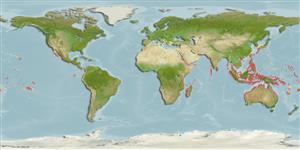
Entorno: milieu / zona climática / rango de profundidad / gama de distribución
Ecología
Benthic; rango de profundidad 0 - 2 m (Referencia 1456). Tropical
Indo-Pacific.
Longitud en la primera madurez / Tamaño / Peso / Edad
Madurez: Lm 1.4, range 1 - 1.8 cm Max length : 12.0 cm TL macho / no sexado; (Referencia 85382)
Minimum depth assumed from its ecology. Inhabits fringing barrier reef (Ref. 2912). Found in mangrove areas (Ref. 2908). Algae-feeding herbivore (Ref. 1456). Uses its radula to excavate a home site for grazing surface algae (Ref. 2907). Occurs at the high tide mark. Found from intertidal to 2 m, on rocks (Ref. 75835).
Ciclo vital y comportamiento de apareamiento
Madurez | Reproducción | Puesta | Huevos | Fecundidad | Larva
Members of the class Polyplacophora are gonochoric. No copulation; males release sperm throught their respiratory currents and females shed the eggs into the sea. Eggs develop into lecithotrophic planktonic trochophore (Ref. 833). First reproduction occurs when individuals have reached the age of two (years) (Ref. 94892). In the Red Sea, spawning occurs during autumn (Ref. 98877).
Dell'Angelo, B., A. Bonfitto, M. Taviani and B. Sabelli 2003 Chitons (Mollusca, Polyplacophora) from bioclastic sands of the Ifaty-Tuléar back reefs (Madagascar, Western Indian Ocean). Bolletino Malacologico 5:45-62. (Referencia 703)
Situación en la Lista Roja de la UICN
(Referencia 130435: Version 2025-2 (Global))
Estatus CITES (Referencia 108899)
Not Evaluated
CMS (Referencia 116361)
Not Evaluated
Amenaza para el ser humano
Harmless
Usos humanos
Pesquerías: comercial
FAO - Publication: search | FishSource | Sea Around Us
Herramientas
Más información
Dinámica de la poblaciónCrecimientoEdades / tallas máximasLongitud-peso rel.Longitud-longitud rel.Longitud-frecuenciasConversión de masasAbundancia FisiologíaConsumo del oxígeno
Relacionados con el ser humanoSellos, monedas, varios
Fuentes de Internet
Estimaciones basadas en modelos
Vulnerabilidad pesquera
(Referencia 71543) |
Low vulnerability (24 of 100). |
Categoría de precios
(Referencia 80766): |
Unknown. |
Nutrients
|
Calcium = 126 [75, 177] mg/100g; Iron = 4.79 [1.67, 7.92] mg/100g; Protein = 16.6 [15.4, 17.8] %; Omega3 = 0.331 [0.263, 0.400] g/100g; Selenium = 57.8 [48.5, 67.2] μg/100g; VitaminA = 0 μg/100g; Zinc = 1.97 [0.92, 3.02] mg/100g (wet weight); based on nutrient studies. |