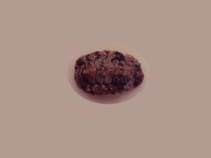
Polyplacophora |
Chitonida |
Chitonidae
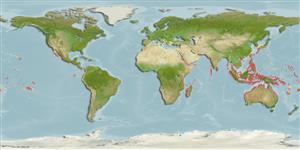
Umwelt: Milieu / Klimazone / Tiefenbereich / Verbreitungsgebiet
Ökologie
Benthic; tiefenbereich 0 - 2 m (Ref. 1456). Tropical
Indo-Pacific.
Länge bei der ersten Reifung / Größe / Gewicht / Alter
Geschlechtsreife: Lm 1.4, range 1 - 1.8 cm Max length : 12.0 cm TL Männchen/unbestimmt; (Ref. 85382)
Minimum depth assumed from its ecology. Inhabits fringing barrier reef (Ref. 2912). Found in mangrove areas (Ref. 2908). Algae-feeding herbivore (Ref. 1456). Uses its radula to excavate a home site for grazing surface algae (Ref. 2907). Occurs at the high tide mark. Found from intertidal to 2 m, on rocks (Ref. 75835).
Members of the class Polyplacophora are gonochoric. No copulation; males release sperm throught their respiratory currents and females shed the eggs into the sea. Eggs develop into lecithotrophic planktonic trochophore (Ref. 833). First reproduction occurs when individuals have reached the age of two (years) (Ref. 94892). In the Red Sea, spawning occurs during autumn (Ref. 98877).
Dell'Angelo, B., A. Bonfitto, M. Taviani and B. Sabelli 2003 Chitons (Mollusca, Polyplacophora) from bioclastic sands of the Ifaty-Tuléar back reefs (Madagascar, Western Indian Ocean). Bolletino Malacologico 5:45-62. (Ref. 703)
IUCN Rote Liste Status
(Ref. 130435: Version 2025-2 (Global))
CITES Status (Ref. 108899)
Not Evaluated
Not Evaluated
Bedrohung für Menschen
Harmless
Nutzung durch Menschen
Fischereien: kommerziell
FAO - Publication: search | FishSource | Das Meer um uns herum
Tools
Mehr Information
PopulationsdynamikWachstumMax. Alter/GrößenLänge-Gewicht-Rel.Länge-Länge-Verhältnis.LängenhäufigkeitenMassenkonvertierungDichte PhysiologieSauerstoffverbrauch
MenschenbezogenBriefmarken, Münzen, Verschiedenes.
Internet Quellen
Schätzungen auf der Grundlage von Modellen
Anfälligkeit der Fischerei
(Ref. 71543) |
Low vulnerability (24 of 100). |
Preiskategorie
(Ref. 80766): |
Unknown. |
Nutrients
|
Calcium = 126 [75, 177] mg/100g; Iron = 4.79 [1.67, 7.92] mg/100g; Protein = 16.6 [15.4, 17.8] %; Omega3 = 0.331 [0.263, 0.400] g/100g; Selenium = 57.8 [48.5, 67.2] μg/100g; VitaminA = 0 μg/100g; Zinc = 1.97 [0.92, 3.02] mg/100g (wet weight); based on nutrient studies. |