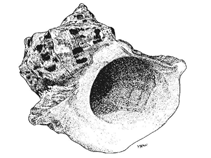
Gastropoda |
Trochida |
Turbinidae
สิ่งแวดล้อม : สิ่งแวดล้อม / เขตภูมิอากาศ / ระดับความลึก / ระยะการกระจายสินค้า
นิเวศวิทยา
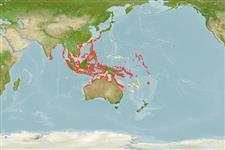
Benthic; ระดับความลึก 1 - 30 m (อ้างอิง 349). Tropical; 31°N - 29°S, 79°E - 180°E
Indo-Pacific: from East Africa, to eastern Melanesia; north to southern Japan and south to northern Queensland and Fiji Islands. Successfully introduced in French Polynesia in the 1960s.
ความยาวเมื่อครบกำหนดครั้งแรก / ขนาด / น้ำหนัก / อายุ
วัยเจริญพันธุ์: Lm ? range ? - ? cm Max length : 22.0 cm SHL เพศผู้/กระเทย; (อ้างอิง 349); common length : 18.0 cm SHL เพศผู้/กระเทย; (อ้างอิง 349)
Extensively used for food, shell jewelry, inlay, and button making. It is the most important commercial species of Turbinidae in the tropical Indo-West Pacific. Intensive fishing for the mother-of-pearl trade has drastically reduced many turban populations in recent years. In order to protect existing resources and to increase the possibilities of long-term exploitations, attempts of juvenile production, reintroduction, translocation, and commercial legislation are under way in the area (Ref. 349). Maximum depth from Ref. 75835. In subtidal, coral reef areas open to a constant flow of clean oceanic water. Juveniles mainly living on reef crests; adults also occurring deeper on slopes to about 20 m or more (Ref. 349). Found at depths of 10 to 30 m, on rocks (Ref. 75835). Primarily herbivorous, with few small animals eaten that are associated with the assemblage of algae (Ref. 105749).
วงจรชีวิตและพฤติกรรมการผสมพันธุ์
วัยเจริญพันธุ์ | การสืบพันธุ์ | การวางไข่ | เซลสืบพันธ์ของเพศเมีย(ไข่) | ความดกของไข่ | ตัวอ่อน
Members of the order Patellogastropoda are mostly gonochoric and broadcast spawners. Life cycle: Embryos develop into planktonic trocophore larvae and later into juvenile veligers before becoming fully grown adults.
Poutiers, J.M. 1998 Gastropods. p. 363-648. In Carpenter, K. E. and V. H. Niem. 1998. FAO species identification guide for fishery purposes. The living marine resources of the Western Central Pacific. Volume 1. Seaweeds, corals, bivalves, and gastropods. Rome, FAO. (อ้างอิง 349)
สถานะบัญชีแดงของ IUCN
(อ้างอิง 130435: Version 2025-2 (Global))
สถานะไซเตส (อ้างอิง 108899)
Not Evaluated
CMS (อ้างอิง 116361)
Not Evaluated
ภัยคุกคามต่อมนุษย์
Harmless
การใช้ของมนุษย์
การประมง: การค้า
FAO - Publication: search | FishSource |
เครื่องมือ
ข้อมูลเพิ่มเติม
พลวัตของประชากรการเจริญเติบโตอายุสูงสุด / ขนาดความยาว-น้ำหนักสัมพันธ์ความยาว-ความยาวสัมพันธ์ความยาว-ความถี่การแปลงมวลอุดมสมบรูณ์ วงจรชีวิตการสืบพันธุ์วัยเจริญพันธุ์ความดกของไข่การวางไข่เซลสืบพันธ์ของเพศเมีย(ไข่)การพัฒนาไข่ตัวอ่อน เกี่ยวข้องกับมนุษย์แสตมป์ เหรียญ อื่นๆ
แหล่งที่มาจากอินเตอร์เน็ต
การประมาณค่าตามแบบจำลอง
ความเสี่ยงต่อการตกปลา
(อ้างอิง 71543) |
Low vulnerability (12 of 100). |
หมวดหมู่ราคา
(อ้างอิง 80766): |
High. |