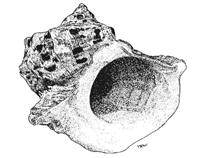
Gastropoda |
Trochida |
Turbinidae
Milieu: milieu / Klimaatzone / Diepte / verspreidingsgebied
Ecologie
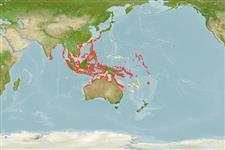
Benthic; diepte 1 - 30 m (Ref. 349). Tropical; 31°N - 29°S, 79°E - 180°E
Indo-Pacific: from East Africa, to eastern Melanesia; north to southern Japan and south to northern Queensland and Fiji Islands. Successfully introduced in French Polynesia in the 1960s.
Lengte bij maturiteit / Grootte / Gewicht / Leeftijd
Maturiteit: Lm ? range ? - ? cm Max length : 22.0 cm SHL mannelijk / geslacht onbekend; (Ref. 349); common length : 18.0 cm SHL mannelijk / geslacht onbekend; (Ref. 349)
Extensively used for food, shell jewelry, inlay, and button making. It is the most important commercial species of Turbinidae in the tropical Indo-West Pacific. Intensive fishing for the mother-of-pearl trade has drastically reduced many turban populations in recent years. In order to protect existing resources and to increase the possibilities of long-term exploitations, attempts of juvenile production, reintroduction, translocation, and commercial legislation are under way in the area (Ref. 349). Maximum depth from Ref. 75835. In subtidal, coral reef areas open to a constant flow of clean oceanic water. Juveniles mainly living on reef crests; adults also occurring deeper on slopes to about 20 m or more (Ref. 349). Found at depths of 10 to 30 m, on rocks (Ref. 75835). Primarily herbivorous, with few small animals eaten that are associated with the assemblage of algae (Ref. 105749).
Levenscyclus en paargedrag
Maturiteit | Voortplanting | Paaien | Eieren | Fecunditeit | Larven
Members of the order Patellogastropoda are mostly gonochoric and broadcast spawners. Life cycle: Embryos develop into planktonic trocophore larvae and later into juvenile veligers before becoming fully grown adults.
Poutiers, J.M. 1998 Gastropods. p. 363-648. In Carpenter, K. E. and V. H. Niem. 1998. FAO species identification guide for fishery purposes. The living marine resources of the Western Central Pacific. Volume 1. Seaweeds, corals, bivalves, and gastropods. Rome, FAO. (Ref. 349)
Status op de Rode Lijst van het IUCN
(Ref. 130435: Version 2025-2 (Global))
CITES status (Ref. 108899)
Not Evaluated
Not Evaluated
Gevaar voor de mens
Harmless
Gebruik door de mens
Visserij: commercieel
FAO - Publication: search | FishSource |
Tools
Meer informatie
LevenscyclusVoortplantingMaturiteitFecunditeitPaaienEierenOntwikkeling van de eierenLarven FysiologieZuurstofverbruik
Menselijk gerelateerdPostzegels, munten, diversen.
Internetbronnen
Schattingen op basis van modellen
Kwetsbaarheid van de visserij
(Ref. 71543) |
Low vulnerability (12 of 100). |
Prijsklasse
(Ref. 80766): |
High. |