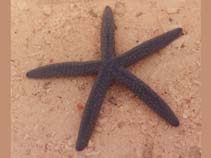
Asteroidea |
Valvatida |
Ophidiasteridae
สิ่งแวดล้อม : สิ่งแวดล้อม / เขตภูมิอากาศ / ระดับความลึก / ระยะการกระจายสินค้า
นิเวศวิทยา
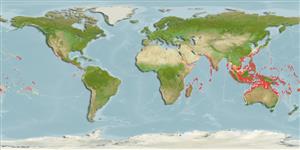
เกี่ยวกับหินโสโครก; ระดับความลึก 0 - 60 m (อ้างอิง 800). Tropical
Indo-Pacific.
ความยาวเมื่อครบกำหนดครั้งแรก / ขนาด / น้ำหนัก / อายุ
วัยเจริญพันธุ์: Lm ? range ? - ? cm Max length : 40.0 cm WD เพศผู้/กระเทย; (อ้างอิง 800)
Occurs in shallow reef areas exposed to the sunlight, on rocks, dead coral or rubble at depths of 0 to 60 m (Ref. 800). Also on a reef slope (Ref. 97449); among sponges, macroalgae and seagrasses (Ref. 82802). Juveniles hide under corals and rocks. Feeds on detritus, small invertebrates living on algal mats and dead animals (Ref. 800). Associated with coral communities. Likely feeds on turf algae and bacterial film over hard substrates (Ref. 129602).
วงจรชีวิตและพฤติกรรมการผสมพันธุ์
วัยเจริญพันธุ์ | การสืบพันธุ์ | การวางไข่ | เซลสืบพันธ์ของเพศเมีย(ไข่) | ความดกของไข่ | ตัวอ่อน
Members of the class Asteroidea exhibit both asexual (regeneration and clonal) and sexual (gonochoric) means of reproduction. Life cycle: Embryos hatch into planktonic larvae and later metamorphose into pentamorous juveniles which develop into young sea stars with stubby arms.
Schoppe, S. 2000 A guide to common shallow water sea stars, brittle stars, sea urchins, sea cucumbers and feather stars (echinoderms) of the Philippines. Times Media Private Limited, Singapore. 144 p. (อ้างอิง 800)
สถานะบัญชีแดงของ IUCN
(อ้างอิง 130435: Version 2025-2 (Global))
สถานะไซเตส (อ้างอิง 108899)
Not Evaluated
CMS (อ้างอิง 116361)
Not Evaluated
ภัยคุกคามต่อมนุษย์
Harmless
การใช้ของมนุษย์
FAO - Publication: search | FishSource |
เครื่องมือ
ข้อมูลเพิ่มเติม
พลวัตของประชากรการเจริญเติบโตอายุสูงสุด / ขนาดความยาว-น้ำหนักสัมพันธ์ความยาว-ความยาวสัมพันธ์ความยาว-ความถี่การแปลงมวลอุดมสมบรูณ์ วงจรชีวิตการสืบพันธุ์วัยเจริญพันธุ์ความดกของไข่การวางไข่เซลสืบพันธ์ของเพศเมีย(ไข่)การพัฒนาไข่ตัวอ่อน เกี่ยวข้องกับมนุษย์แสตมป์ เหรียญ อื่นๆ
แหล่งที่มาจากอินเตอร์เน็ต
การประมาณค่าตามแบบจำลอง
ความเสี่ยงต่อการตกปลา
(อ้างอิง 71543) |
Low to moderate vulnerability (30 of 100). |
หมวดหมู่ราคา
(อ้างอิง 80766): |
Unknown. |