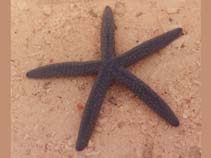
Asteroidea |
Valvatida |
Ophidiasteridae
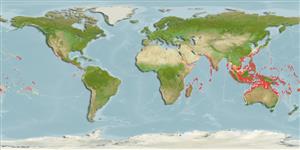
पर्यावरण: पर्यावरण / जलवायु क्षेत्र / गहराई सीमा / वितरण सीमा
पारिस्थितिकी
प्रवाल-भित्ति संयुक्त; गहराई सीमा 0 - 60 m (संदर्भ 800). Tropical
Indo-Pacific.
प्रथम परिपक्वता पर लंबाई / आकार / वज़न / आयु
परिपक्व अवधि: Lm ? range ? - ? cm Max length : 40.0 cm WD पुल्लिंग / अलिंग; (संदर्भ 800)
Occurs in shallow reef areas exposed to the sunlight, on rocks, dead coral or rubble at depths of 0 to 60 m (Ref. 800). Also on a reef slope (Ref. 97449); among sponges, macroalgae and seagrasses (Ref. 82802). Juveniles hide under corals and rocks. Feeds on detritus, small invertebrates living on algal mats and dead animals (Ref. 800). Associated with coral communities. Likely feeds on turf algae and bacterial film over hard substrates (Ref. 129602).
जीवन चक्र और संभोग व्यवहार
परिपक्व अवधि | पुनरुत्पत्ति | मछलीऔ का अंडे देना | अंडे | उपजाऊपन | लार्वा
Members of the class Asteroidea exhibit both asexual (regeneration and clonal) and sexual (gonochoric) means of reproduction. Life cycle: Embryos hatch into planktonic larvae and later metamorphose into pentamorous juveniles which develop into young sea stars with stubby arms.
Schoppe, S. 2000 A guide to common shallow water sea stars, brittle stars, sea urchins, sea cucumbers and feather stars (echinoderms) of the Philippines. Times Media Private Limited, Singapore. 144 p. (संदर्भ 800)
आईयूसीएन रेड लिस्ट स्थिति
(संदर्भ 130435: Version 2025-2 (Global))
CITES स्थिति (संदर्भ 108899)
Not Evaluated
CMS (संदर्भ 116361)
Not Evaluated
मनुष्यों के लिए ख़तरा
Harmless
मानव उपयोग
FAO - Publication: search | FishSource |
साधन
अधिक जानकारी
जनसंख्या गतिशीलताबाढ़अधिकतम आयु/आकारलंबाई-वजन संबंधलंबाई-लंबाई संबंधलंबाई-आवृत्तियाँसामूहिक रूपांतरणबहुतायत जीवन चक्रपुनरुत्पत्तिपरिपक्व अवधिउपजाऊपनमछलीऔ का अंडे देनाअंडेअंडे का विकासलार्वा फिजियोलॉजीप्राणवायु की खपत
मानव संबंधीटिकट, सिक्के, विविध.
इंटरनेट स्रोत
मॉडल पर आधारित अनुमान
मछली पकड़ने की भेद्यता
(संदर्भ 71543) |
Low to moderate vulnerability (30 of 100). |
मूल्य श्रेणी
(संदर्भ 80766): |
Unknown. |