Bivalvia |
Pectinida |
Pectinidae
Entorno: milieu / zona climática / rango de profundidad / gama de distribución
Ecología
Benthic; rango de profundidad 0 - 20 m (Referencia 348). Tropical
Distribución
Territories | Áreas FAO | Ecosistemas | Ocurrencias, apariciones | Introducciones
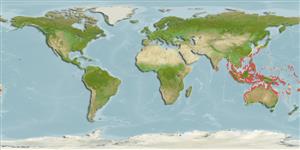
Indo-West Pacific: from India to Melanesia; north Japan and south to Queensland and New Caledonia.
Longitud en la primera madurez / Tamaño / Peso / Edad
Madurez: Lm ? range ? - ? cm Max length : 9.5 cm SHL macho / no sexado; (Referencia 348); common length : 7.0 cm macho / no sexado; (Referencia 348)
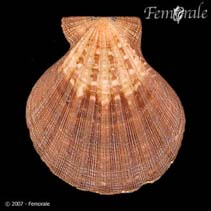
Shell solid, medium sized, higher than long, elongate-ovate in outline. Both valves convex, the right (lower) valve more inflated than the left (upper) valve. Ears subequal in size and shape. Right anterior ear with a slight byssal notch anteroventrally, devoid of ctenolium. Outer sculpture of about 10 or 11 rounded radial folds (9 to 13) on each valve, with numerous, much smaller, secondary radial riblets that are set with densely and finely imbricated transverse scales, giving a rather strongly scabrous aspect. Surface of ears with distinct radial ridges (more developed on right anterior ear). Hinge line quite long, about 2/3 of shell length, with shallow marginal ridges. Interior of valves shiny, with a flattened radial sculpture corresponding with the outer folds. Colour: outside of shell off-white to interior satin white, with dark brown on the hinge line.
Attached to rock, coral and other hard objects. Common on coarse sand in coral reef areas. Intertidal and shallow subtidal waters (Ref. 348).
Ciclo vital y comportamiento de apareamiento
Madurez | Reproducción | Puesta | Huevos | Fecundidad | Larva
Members of the class Bivalvia are mostly gonochoric, some are protandric hermaphrodites. Life cycle: Embryos develop into free-swimming trocophore larvae, succeeded by the bivalve veliger, resembling a miniature clam.
Poutiers, J.M. 1998 Bivalves. Acephala, Lamellibranchia, Pelecypoda. p. 123-362. In Carpenter, K. E. and V. H. Niem. 1998. FAO species identification guide for fishery purposes. The living marine resources of the Western Central Pacific. Volume 1. Seaweeds, corals, bivalves, and gastropods. Rome, FAO. (Referencia 348)
Situación en la Lista Roja de la UICN
(Referencia 130435: Version 2025-2 (Global))
Estatus CITES (Referencia 108899)
Not Evaluated
CMS (Referencia 116361)
Not Evaluated
Amenaza para el ser humano
Harmless
Usos humanos
FAO - Publication: search | FishSource |
Herramientas
Más información
Ecología TróficaAlimentos (presas)
Composición de la dieta
consumo de alimento
Despredadores
Dinámica de la poblaciónCrecimientoEdades / tallas máximasLongitud-peso rel.Longitud-longitud rel.Longitud-frecuenciasConversión de masasAbundancia Ciclo de vidaReproducciónMadurezFecundidadPuestaHuevosDesarrollo de los huevosLarva FisiologíaConsumo del oxígeno
Relacionados con el ser humanoSellos, monedas, varios
Fuentes de Internet
Estimaciones basadas en modelos
Vulnerabilidad pesquera
(Referencia 71543) |
Low vulnerability (10 of 100). |
Categoría de precios
(Referencia 80766): |
Medium. |