Bivalvia |
Pectinida |
Pectinidae
Meio ambiente: milieu / Zona climática / intervalo de profundidade / faixa de distribuição
Ecologia
Benthic; intervalo de profundidade 0 - 20 m (Ref. 348). Tropical
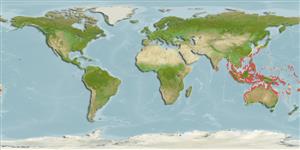
Indo-West Pacific: from India to Melanesia; north Japan and south to Queensland and New Caledonia.
Comprimento de primeira maturação / Tamanho / Peso / Idade
Maturidade: Lm ? range ? - ? cm Max length : 9.5 cm SHL macho/indeterminado; (Ref. 348); common length : 7.0 cm macho/indeterminado; (Ref. 348)
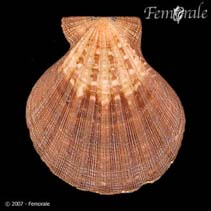
Shell solid, medium sized, higher than long, elongate-ovate in outline. Both valves convex, the right (lower) valve more inflated than the left (upper) valve. Ears subequal in size and shape. Right anterior ear with a slight byssal notch anteroventrally, devoid of ctenolium. Outer sculpture of about 10 or 11 rounded radial folds (9 to 13) on each valve, with numerous, much smaller, secondary radial riblets that are set with densely and finely imbricated transverse scales, giving a rather strongly scabrous aspect. Surface of ears with distinct radial ridges (more developed on right anterior ear). Hinge line quite long, about 2/3 of shell length, with shallow marginal ridges. Interior of valves shiny, with a flattened radial sculpture corresponding with the outer folds. Colour: outside of shell off-white to interior satin white, with dark brown on the hinge line.
Attached to rock, coral and other hard objects. Common on coarse sand in coral reef areas. Intertidal and shallow subtidal waters (Ref. 348).
Ciclo de vida ou comportamento de acasalamento
Maturidade | Reprodução | Desova | Ovos | Fecundidade | Larvas
Members of the class Bivalvia are mostly gonochoric, some are protandric hermaphrodites. Life cycle: Embryos develop into free-swimming trocophore larvae, succeeded by the bivalve veliger, resembling a miniature clam.
Poutiers, J.M. 1998 Bivalves. Acephala, Lamellibranchia, Pelecypoda. p. 123-362. In Carpenter, K. E. and V. H. Niem. 1998. FAO species identification guide for fishery purposes. The living marine resources of the Western Central Pacific. Volume 1. Seaweeds, corals, bivalves, and gastropods. Rome, FAO. (Ref. 348)
Status na Lista Vermelha da UICN
(Ref. 130435: Version 2025-2 (Global))
Status no CITES (Ref. 108899)
Not Evaluated
Not Evaluated
Ameaça para os humanos
Harmless
Uso pelos humanos
FAO - Publication: search | FishSource |
Ferramentas
Mais informação
Ecologia TróficaItens alimentares (presas)
Composição da dieta
Consumo alimentar
Predadores
Dinâmica populacionalCrescimentoIdade máxima / tamanhosRelação comprimento-peso.Relação comprimento-comprimento.Frequências de comprimentoConversão de massaAbundância Ciclo de vidaReproduçãoMaturidadeFecundidadeDesovaOvosDesenvolvimento dos ovosLarvas FisiologiaConsumo de oxigênio
Relacionado a humanosSelos, moedas, diversos.
Fontes da internet
Estimativas baseadas em modelos
Vulnerabilidade da pesca
(Ref. 71543) |
Low vulnerability (10 of 100). |
Categoria de preço
(Ref. 80766): |
Medium. |