Gastropoda |
Aplysiida |
Aplysiidae
Miljö: miljö / Klimatzon / djupintervall / distributionsområde
Ekologi
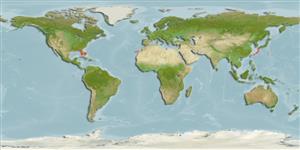
Benthic; djupintervall 0 - 20 m (Ref. 7727). Tropical; 44°N - 5°S, 98°W - 37°E
Atlantic Ocean and the Mediterranean.
Längd vid första mognad / Storlek / Vikt / Ålder
Könsmognad: Lm ? range ? - ? cm Max length : 41.0 cm TL hane/ej könsbestämd; (Ref. 126605); publicerad maxvikt: 1.4 kg (Ref. 126605); rapporterad maxålder: 1.00 år (Ref. 126605)
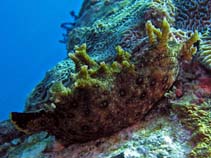
Sea hares have annual life cycles (Ref. 126605). Common on tidal platforms of mixed sand and rock; actively crawling in tide pools at night and in crevices and under rocks during the day (Ref. 866). Grazes on various types of green algae (Ref. 844). Found in warm seas (Ref. 822). Known from depths of 0 to 20 m (Ref. 7727); from low intertidal to immediate subtidal on alga-covered reefs (Ref. 337). Ejecting ink as a predator deterrence and to send alarm signals to conspecifics, but not all spotted sea hares have ink (Ref. 84419). Ink components are based on the chemical properties of their diet (Ref. 84420). Ascorhynchus sp. found parasitic on the gills of this nudibranch (Ref. 121217).
Livscykel och parningsbeteende
Könsmognad | Reproduktion | Lek | Ägg | Fekunditet | Larver
Members of the order Anaspidea are mostly simultaneous hermaphrodites.
Debelius, H. 2001 Nudibranchs and sea snails: Indo-Pacific field guide. Unterwasserarchiv, IKAN, frankfurt, Germany, 3rd ed. 321 pp. (Ref. 844)
Status på IUCN:s rödlista
(Ref. 130435: Version 2025-2 (Global))
CITES-status (Ref. 108899)
Not Evaluated
Not Evaluated
Hot mot människor
Mänskliga användningsområden
FAO - Publication: search | FishSource |
Verktyg
Ytterligare information
Trofisk ekologiLivsmedelsartiklar (preys)
Födosammansättning
Födointag
Predatorer
LivscykelReproduktionKönsmognadFekunditetLekÄggUtveckling av äggLarver MänniskorelateradFrimärken, mynt, diverse.
Internet-källor
Uppskattningar baserade på modeller
Sårbarhet i fisket
(Ref. 71543) |
Low vulnerability (21 of 100). |
Priskategori
(Ref. 80766): |
Unknown. |