Bivalvia |
Ostreida |
Pinnidae
Environnement : milieu / zone climatique / profondeur / gamme de distribution
Écologie
Benthic; profondeur 0 - 50 m (Réf. 75831). Tropical
Indo-Pacific: from East Africa, including Madagascar, the Red Sea and the Persian Gulf, to eastern Polynesia; north to Japan and Hawaii, and south to Queensland and New Caledonia.
Longueur à la première maturité / Taille / Poids / Âge
Maturité: Lm ? range ? - ? cm Max length : 48.0 cm SHL mâle / non sexé; (Réf. 348); common length : 30.0 cm SHL mâle / non sexé; (Réf. 348)
Description synthétique
Morphologie
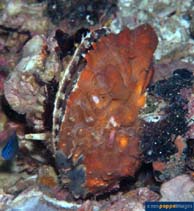
Shell reaching a very large size, thick and solid, inflated, variable in shape from triangular to hatchet-shaped or subglobular. Dorsal margin usually nearly straight, posterior margin broadly oval to somewhat truncate in outline. Ventral margin broadly convex posteriorly and concave near the umbones, often strongly lobate in medium-sized and large specimens. Outside of valves with 10 to 17 main radial ribs, often bearing scale-like spines, and with weaker interstitial riblets. Internal nacreous layer moderately strong, undivided, occupying the anterior half or 2/3 of valves. Hind margin of posterior adductor scar slightly protruding beyond the nacreous area (protrusion of adductor scar more developed in mature specimens). Colour: outside of shell dark reddish brown to nearly black, usually dull. Shell material semitranslucent, appearing a rich reddish purple when viewed with transmitted light. Interior dark brown to black, iridescent on nacreous area.
Because it attains a large size, this common species is probably one of the most economically important members of the family in the Indo-West Pacific. Beautiful but fragile black pearls are sometimes produced by the animal (Ref. 348). Intertidal to subtidal, on sand and mud (Ref. 75840).
Cycle de vie et comportement reproducteur
Maturité | Reproduction | Frai | Œufs | Fécondité | Larves
Members of the class Bivalvia are mostly gonochoric, some are protandric hermaphrodites. Life cycle: Embryos develop into free-swimming trocophore larvae, succeeded by the bivalve veliger, resembling a miniature clam.
Poutiers, J.M. 1998 Bivalves. Acephala, Lamellibranchia, Pelecypoda. p. 123-362. In Carpenter, K. E. and V. H. Niem. 1998. FAO species identification guide for fishery purposes. The living marine resources of the Western Central Pacific. Volume 1. Seaweeds, corals, bivalves, and gastropods. Rome, FAO. (Réf. 348)
Statut dans la liste rouge de l'IUCN
(Réf. 130435: Version 2025-2 (Global))
statut CITES (Réf. 108899)
Not Evaluated
Not Evaluated
Menace pour l'homme
Harmless
Utilisations par l'homme
Pêcheries: commercial
FAO - Publication: search | FishSource |
Outils
Plus d'informations
Écologie trophiqueAliments (proies)
Composition du régime alimentaire
Consommation alimentaire
Prédateurs
Dynamique des populationsCroissanceÂges / tailles maximalesLongueur-poids rel.Rel. longueur-longueur.Fréquences de longueursConversion de masseAbondance Cycle de vieReproductionMaturitéFéconditéFraiŒufsDéveloppement de l'œufLarves PhysiologieConsommation d'oxygène
Liées à l'hommeTimbres, pièces de monnaie, divers
Sources Internet
Estimations basées sur des modèles
Vulnérabilité de la pêche
(Réf. 71543) |
Moderate vulnerability (38 of 100). |
Catégorie de prix
(Réf. 80766): |
Unknown. |