Bivalvia |
Cardiida |
Cardiidae
สิ่งแวดล้อม : สิ่งแวดล้อม / เขตภูมิอากาศ / ระดับความลึก / ระยะการกระจายสินค้า
นิเวศวิทยา
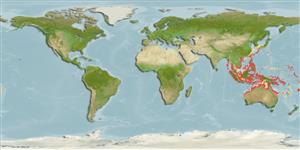
Benthic; ระดับความลึก 0 - 35 m (อ้างอิง 75831). Tropical; 23°C - 30°C (อ้างอิง 102835); 38°N - 29°S, 92°E - 178°W
Indo-Pacific: from Myanmar then east to Wallis and Futuna, north to Japan and south to western Australia. Introduced beyond Wallis and Futuna in the Pacific.
ความยาวเมื่อครบกำหนดครั้งแรก / ขนาด / น้ำหนัก / อายุ
วัยเจริญพันธุ์: Lm ?, range 25 - 35 cm Max length : 137 cm SHL เพศผู้/กระเทย; (อ้างอิง 99323); common length : 80.0 cm SHL เพศผู้/กระเทย; (อ้างอิง 348); น้ำหนักสูงสุดที่มีการรายงาน: 500.0 kg (อ้างอิง 81839)
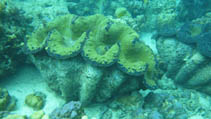
It is white and fan-shaped with deep radiating ribs.
Known to be the largest bivalve mollusks that exist. Exploited for its meat and shell, this species has recently become nearly extinct within an important part of its range, due to over collecting. Trials of aquaculture under progress for the restocking of reefs and local farming (Ref. 348). Facultative planktotroph. It has an established symbiotic relationship with a dinoflagellate algae (zooxanthellae) which allows them to survive. It ingests the algae at an early stage and the latter propagates in the gut (Ref. 100719).
วงจรชีวิตและพฤติกรรมการผสมพันธุ์
วัยเจริญพันธุ์ | การสืบพันธุ์ | การวางไข่ | เซลสืบพันธ์ของเพศเมีย(ไข่) | ความดกของไข่ | ตัวอ่อน
Becomes simultaneous hermaphrodite in its later years. Spawning is seasonal, based on its northern and southern limits of distribution (Ref. 100714).
SAUP Database 2006 SAUP Database. www.seaaroundus.org. (อ้างอิง 356)
สถานะบัญชีแดงของ IUCN
(อ้างอิง 130435: Version 2025-2 (Global))
สถานะไซเตส (อ้างอิง 108899)
CMS (อ้างอิง 116361)
Not Evaluated
ภัยคุกคามต่อมนุษย์
การใช้ของมนุษย์
การประมง: การค้า; การเพาะเลี้ยงสัตว์น้ำ: การค้า
FAO - Aquaculture Systems: production search; Publication: search | FishSource | ทะเลรอบๆเรา
เครื่องมือ
ข้อมูลเพิ่มเติม
เกี่ยวข้องกับมนุษย์แสตมป์ เหรียญ อื่นๆ
แหล่งที่มาจากอินเตอร์เน็ต
การประมาณค่าตามแบบจำลอง
ความสามารถในการกลับคืนสู่ปกติ
(Ref. 69278): |
ต่ำ, เวลาต่ำสุดที่จะทำให้ประชากรเพิ่มขึ้นเป็น 2 เท่าใช้เวลา 4.5 - 14 ปี (K=0.07-0.2) |
ความเสี่ยงต่อการตกปลา
(อ้างอิง 71543) |
High to very high vulnerability (73 of 100). |
หมวดหมู่ราคา
(อ้างอิง 80766): |
Unknown. |
Nutrients
|
Calcium = 149 [71, 228] mg/100g; Iron = 8.53 [1.95, 15.11] mg/100g; Protein = 9.88 [8.64, 11.12] %; Omega3 = 0.313 [0.202, 0.423] g/100g; Selenium = 61 [50, 72] μg/100g; VitaminA = 0 μg/100g; Zinc = 2.04 [0.56, 3.51] mg/100g (wet weight); based on nutrient studies. |