Bivalvia |
Mytilida |
Mytilidae
Environnement : milieu / zone climatique / profondeur / gamme de distribution
Écologie
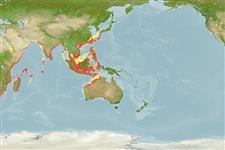
Benthic; saumâtre; profondeur 0 - 100 m (Réf. 356), usually 0 - 20 m. Tropical, preferred 25°C (Réf. 107945); 46°N - 35°S, 20°E - 130°E (Réf. 348)
Indo-Pacific and Western Central Atlantic.
Longueur à la première maturité / Taille / Poids / Âge
Maturité: Lm ? range ? - ? cm Max length : 16.5 cm SHL mâle / non sexé; (Réf. 348); common length : 8.0 cm SHL mâle / non sexé; (Réf. 348)
Description synthétique
Morphologie
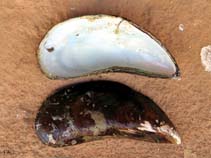
Shell elongate, roughly trigonal-ovate in outline, swollen and pointed anteriorly, rounded and compressed posteriorly. Umbones terminal and sharply tapering, rather incurved. Anterior margin reduced. Ventral margin long and often somewhat concave. Outer surface nearly smooth apart from concentric growth marks and faint radial lines. Periostracum rather thick and smooth, adherent. Ligamental ridge finely pitted. Hinge with 1 small tooth in right valve and 2 in the left. Anterior adductor scar absent in adult specimens. Posterior retractor scars large, confluent with the posterior adductor scar. Anterior retractor scar separated, elongate-ovate in shape, situated a short way to posterior end of ligament. Internal margins smooth. Colour: outside of shell whitish under a bright periostracum which is dark brownish green anteriorly and olive-green to bright green posteriorly. Interior an iredescent pale bluish green, with a vivid green margin on periostracum.
The figures from FAO comprise the production of Mytilus viridis from Malaysia and Singapore and also production reported under the name Mytilus smaragdinus from the Philippines and Thailand; they all refer to the same species (Ref. 348). Commonly found byssally attached to various hard objects or substrates in protected bays and estuaries (Ref. 80041). Littoral and sublittoral to a depth of 20 m (Ref. 348). Can thrive even in adverse environments due to its ability to tolerate elevated levels of pollutants and oxygen depletion (Ref. 125512).
Cycle de vie et comportement reproducteur
Maturité | Reproduction | Frai | Œufs | Fécondité | Larves
External sexual fertilization. Spawning peaks coincide with monsoon seasons except in the Philippines and Thailand where spawning is year-round (Ref. 80527). Both sexes release gametes in the water column, where developed larvae remain for two weeks before settling in benthic habitat as juveniles. Sexual maturity occurs at 15-30 mm shell length, roughly 2-3 months age.
Poutiers, J.M. 1998 Bivalves. Acephala, Lamellibranchia, Pelecypoda. p. 123-362. In Carpenter, K. E. and V. H. Niem. 1998. FAO species identification guide for fishery purposes. The living marine resources of the Western Central Pacific. Volume 1. Seaweeds, corals, bivalves, and gastropods. Rome, FAO. (Réf. 348)
Statut dans la liste rouge de l'IUCN
(Réf. 130435: Version 2025-2 (Global))
statut CITES (Réf. 108899)
Not Evaluated
Not Evaluated
Menace pour l'homme
Utilisations par l'homme
Pêcheries: hautement commercial
FAO - Aquaculture Systems: production searchpêcheries: Résumé espèce, landings search; Publication: search | FishSource | Sea Around Us
Outils
Plus d'informations
Écologie trophiqueAliments (proies)Composition du régime alimentaireConsommation alimentairePrédateurs Dynamique des populations Cycle de vieReproductionMaturitéFéconditéFraiŒufsDéveloppement de l'œufLarves PhysiologieConsommation d'oxygène
Liées à l'hommeTimbres, pièces de monnaie, divers
Sources Internet
Estimations basées sur des modèles
Résilience
(Ref. 69278): |
Haut, temps minimum de doublement de population inférieur à 15 mois (K=0.17-2.37) |
Vulnérabilité de la pêche
(Réf. 71543) |
Low vulnerability (10 of 100). |
Vulnérabilité climatique
(Réf. 125649) |
Moderate to high vulnerability (48 of 100) |
Catégorie de prix
(Réf. 80766): |
Medium. |
Nutrients
|
Calcium = 149 [71, 228] mg/100g; Iron = 8.53 [1.95, 15.11] mg/100g; Protein = 9.88 [8.64, 11.12] %; Omega3 = 0.313 [0.202, 0.423] g/100g; Selenium = 61 [50, 72] μg/100g; VitaminA = 0 μg/100g; Zinc = 2.04 [0.56, 3.51] mg/100g (wet weight); based on nutrient studies. |