Malacostraca |
Decapoda |
Portunidae
Ambiente: milieu / zona climatica / distribuzione batimetrica / gamma di distribuzione
Ecologia
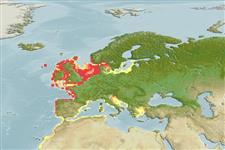
Benthic; distribuzione batimetrica 0 - 80 m (Fonte Biblio. 356), usually ? - 40 m (Fonte Biblio. 435). Temperate; 4°C - 28°C (Fonte Biblio. 112013), preferred 9°C (Fonte Biblio. 107945); 61°N - 24°N, 16°W - 28°E
Atlantic and the Mediterranean Sea: From western Norway to the UK to Western Sahara and the Mediterranean coasts of Spain, France and Italy. Subtropical to temperate.
Lunghezza alla prima maturità / Dimensione / Peso / Età
Maturità: Lm 4.8, range 4 - 5.95 cm Max length : 10.9 cm CL maschio/sesso non determinato; (Fonte Biblio. 96051); 9.84 cm CL (female); common length : 4.5 cm CL maschio/sesso non determinato; (Fonte Biblio. 435); Età massima riportata: 8 anni (Fonte Biblio. 96051)
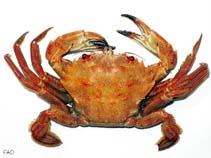
Maximum depth range from Ref. 101396. Maximum carapace width: 8.4; common carapace width: 5.5 cm (Ref. 435). Common in shallow waters from the intertidal to 80 m (Ref. 83653), common at depths not deeper than 40 m (Ref. 435). Found mostly in rocky shores, confined to the lower tidal mark (Refs. 101396). Inhabits on sand or mud (Ref. 435). Carnivore; trophic level 2.6 (Ref. 96418), trophic level 2.98 (Ref. 435). An opportunistic feeder, mostly preys on molluscs and crustaceans and also feeds on detrital material and large quantities of brown algae (Ref. 96482).
Members of the order Decapoda are mostly gonochoric. Mating behavior: Precopulatory courtship ritual is common (through olfactory and tactile cues); usually indirect sperm transfer.
SAUP Database 2006 SAUP Database. www.seaaroundus.org. (Fonte Biblio. 356)
Stato della Lista Rossa IUCN
(Fonte Biblio. 130435: Version 2025-2 (Global))
Stato della CITES (Fonte Biblio. 108899)
Not Evaluated
CMS (Fonte Biblio. 116361)
Not Evaluated
Minaccia per l'uomo
Usi umani
Pesca: commerciale
FAO - pesca: landings search; Publication: search | FishSource | Sea Around Us
Strumenti
Informazioni ulteriori
Dinamica della popolazione FisiologiaConsumo di ossigeno
Legato all'uomoFrancobolli, monete, materiale vario.
Fonti Internet
Stime basate su modelli
Vulnerabilità della pesca
(Fonte Biblio. 71543) |
Low to moderate vulnerability (33 of 100). |
Vulnerabilità climatica
(Fonte Biblio. 125649) |
High vulnerability (56 of 100) |
Categoria di prezzo
(Fonte Biblio. 80766): |
Very high. |
Nutrients
|
Calcium = 109 [35, 184] mg/100g; Iron = 1.59 [1.21, 1.97] mg/100g; Protein = 20.2 [19.2, 21.3] %; Omega3 = 0.285 [0.185, 0.386] g/100g; Selenium = 48.3 [-31.7, 128.3] μg/100g; VitaminA = 0 μg/100g; Zinc = 1.79 [1.17, 2.40] mg/100g (wet weight); based on nutrient studies. |