Bivalvia |
Arcida |
Arcidae
Meio ambiente: milieu / Zona climática / intervalo de profundidade / faixa de distribuição
Ecologia
Benthic; intervalo de profundidade 0 - 20 m. Tropical
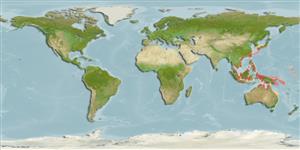
Western Pacific.
Comprimento de primeira maturação / Tamanho / Peso / Idade
Maturidade: Lm ?, range 2 - ? cm Max length : 11.5 cm TL macho/indeterminado; (Ref. 348); common length : 8.0 cm TL macho/indeterminado; (Ref. 348)
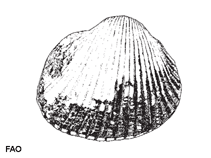
Shell rather thin but solid, strongly inflated, oval subquadrate in shape with rounded ventral margin, almost as high as long; slightly inequivalve, left valve overlapping the right valve on ventral and posterior margins. Cardinal area moderately large. About 34 radial ribs (32 to 36) at each valve; ribs stout and flat, larger than the interstices, smooth on both valves. Periostracum coarse and concentrically striated, easily detached, forming rows of foliations in the interstices of ribs. Internal margins with strong crenulations corresponding with the external radial ribs. No byssal gape. Colour: outside of shell white under the dark brown periostracum. Inner side bluish white.
On fine muddy-sand bottoms, in bays and coastal lagoons. Littoral and sublittoral to a depth of 20 m (Ref. 348).
Ciclo de vida ou comportamento de acasalamento
Maturidade | Reprodução | Desova | Ovos | Fecundidade | Larvas
Life cycle: Embryos develop into free-swimming trocophore larvae, succeeded by the bivalve veliger, resembling a miniature clam (Ref. 833).
Poutiers, J.M. 1998 Bivalves. Acephala, Lamellibranchia, Pelecypoda. p. 123-362. In Carpenter, K. E. and V. H. Niem. 1998. FAO species identification guide for fishery purposes. The living marine resources of the Western Central Pacific. Volume 1. Seaweeds, corals, bivalves, and gastropods. Rome, FAO. (Ref. 348)
Status na Lista Vermelha da UICN
(Ref. 130435: Version 2025-2 (Global))
Status no CITES (Ref. 108899)
Not Evaluated
Not Evaluated
Ameaça para os humanos
Harmless
Uso pelos humanos
Pescarias: espécies comerciais
FAO - Publication: search | FishSource |
Ferramentas
Mais informação
Ecologia TróficaItens alimentares (presas)
Composição da dieta
Consumo alimentar
Predadores
Dinâmica populacionalCrescimento
Idade máxima / tamanhos
Relação comprimento-peso.
Relação comprimento-comprimento.
Frequências de comprimento
Conversão de massa
Abundância
FisiologiaConsumo de oxigênio
Relacionado a humanosSelos, moedas, diversos.
Fontes da internet
Estimativas baseadas em modelos
Vulnerabilidade da pesca
(Ref. 71543) |
Low vulnerability (10 of 100). |
Categoria de preço
(Ref. 80766): |
Unknown. |