Bivalvia |
Arcida |
Arcidae
Umwelt: Milieu / Klimazone / Tiefenbereich / Verbreitungsgebiet
Ökologie
Benthic; tiefenbereich 0 - 20 m. Tropical
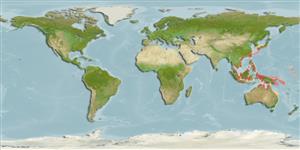
Western Pacific.
Länge bei der ersten Reifung / Größe / Gewicht / Alter
Geschlechtsreife: Lm ?, range 2 - ? cm Max length : 11.5 cm TL Männchen/unbestimmt; (Ref. 348); common length : 8.0 cm TL Männchen/unbestimmt; (Ref. 348)
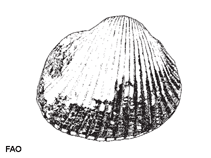
Shell rather thin but solid, strongly inflated, oval subquadrate in shape with rounded ventral margin, almost as high as long; slightly inequivalve, left valve overlapping the right valve on ventral and posterior margins. Cardinal area moderately large. About 34 radial ribs (32 to 36) at each valve; ribs stout and flat, larger than the interstices, smooth on both valves. Periostracum coarse and concentrically striated, easily detached, forming rows of foliations in the interstices of ribs. Internal margins with strong crenulations corresponding with the external radial ribs. No byssal gape. Colour: outside of shell white under the dark brown periostracum. Inner side bluish white.
On fine muddy-sand bottoms, in bays and coastal lagoons. Littoral and sublittoral to a depth of 20 m (Ref. 348).
Life cycle: Embryos develop into free-swimming trocophore larvae, succeeded by the bivalve veliger, resembling a miniature clam (Ref. 833).
Poutiers, J.M. 1998 Bivalves. Acephala, Lamellibranchia, Pelecypoda. p. 123-362. In Carpenter, K. E. and V. H. Niem. 1998. FAO species identification guide for fishery purposes. The living marine resources of the Western Central Pacific. Volume 1. Seaweeds, corals, bivalves, and gastropods. Rome, FAO. (Ref. 348)
IUCN Rote Liste Status
(Ref. 130435: Version 2025-2 (Global))
CITES Status (Ref. 108899)
Not Evaluated
Not Evaluated
Bedrohung für Menschen
Harmless
Nutzung durch Menschen
Fischereien: kommerziell
FAO - Publication: search | FishSource |
Tools
Mehr Information
Trophische ÖkologieLebensmittel (Beutetiere)
Nahrungszusammensetzung
Nahrungsaufnahme
Räuber
PopulationsdynamikWachstum
Max. Alter/Größen
Länge-Gewicht-Rel.
Länge-Länge-Verhältnis.
Längenhäufigkeiten
Massenkonvertierung
Dichte
PhysiologieSauerstoffverbrauch
MenschenbezogenBriefmarken, Münzen, Verschiedenes.
Internet Quellen
Schätzungen auf der Grundlage von Modellen
Anfälligkeit der Fischerei
(Ref. 71543) |
Low vulnerability (10 of 100). |
Preiskategorie
(Ref. 80766): |
Unknown. |