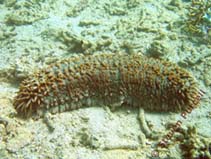
Holothuroidea |
Synallactida |
Stichopodidae
Environnement : milieu / zone climatique / profondeur / gamme de distribution
Écologie
Récifal; profondeur 0 - 50 m (Réf. 800). Tropical; 31°N - 25°S, 31°E - 134°W
Indo-Pacific excluding Hawaii.
Longueur à la première maturité / Taille / Poids / Âge
Maturité: Lm ?, range 30 - ? cm Max length : 80.0 cm TL mâle / non sexé; (Réf. 122); common length : 45.0 cm TL mâle / non sexé; (Réf. 122); poids max. publié: 7.0 kg (Réf. 122)
Description synthétique
Morphologie
Mean live weight: 2500-7000 g. Body-wall thickness: 0.15 cm. Body firm, rigid, flattened ventrally (trivium). Bivium entirely covered with characteristic, large, leaf-shaped, lobate papillae. Trivium with brown to pink podia, more numerous on the radii, their disc about 0.04 cm in diameter, Mouth ventral, surrounded by a circle of conical papillae which are larger on dorsal side, and 20 large, brown tentacles. Anus terminal. Calcareous ring with large radial pieces and narrow interradials. Cuvierian tubules absent. Color variable on bivium, reddish orange to brown; trivium generally red; mature gonads deep purple. Spicules on tegument with cross-shaped spicules, spiny branched spicules (sometimes with median pillar), perforated plates, pseudo-tables, and grains; branched spicules larger in dorsal tegument and papillae; ventral podia with branched spicules, long rods, and large, multiperforated plates; tentacles with characteristic branched spicules, in form of a "rose-window".
Populations not reaching very high densities, with a mean of around 0.003 per square meter. Harvested by hand. Collected by skin diving or using diving gear (if not banned), making the populations very vulnerable, due to overexploitation. The processed product is of major quality and the demand is still high (Ref. 122). Maximum depth from Ref. 122154. A common reef species mostly found from near the surface to a depth of 25 m; generally occurs on hard bottoms, large rubble and coral patches, on reef slopes and near passes. Symbiotic pearlfish (Carapidae, Ophidiiformes) are often found in its general cavity (Ref. 122); common on exposed sandy bottoms or rubble areas of the reef fringe from 10 to 30 m (Ref. 800). Also found on seagrass (Ref. 122153). Associated with commensal pearlfish that live in the body cavity (Ref. 800). This is also found in lagoons at depths up to 30 m on clean sandy bottoms or on slabs near large coral heads. It feeds exclusively on calcareous alga Halimeda sp. (Ref. 118).
Cycle de vie et comportement reproducteur
Maturité | Reproduction | Frai | Œufs | Fécondité | Larves
Sexual reproduction takes places during warm season. A species with a low potential fecundity and late sexual maturity.
Conand, C. 1998 Holothurians (sea cucumbers, Class Holothuroidea). p. 1157-1190. In Carpenter, K.E. and V.H. Niem (eds.) FAO Species Identification Guide for Fishery Purposes. The Living Marine Resources of the Western Central Pacific. Vol. 2. Cephalopods, crustaceans, holothurians and sharks. FAO Rome. (Réf. 122)
Statut dans la liste rouge de l'IUCN
(Réf. 130435: Version 2025-2 (Global))
statut CITES (Réf. 108899)
Not Evaluated
Menace pour l'homme
Harmless
Utilisations par l'homme
Pêcheries: hautement commercial
FAO - pêcheries: landings search; Publication: search | FishSource |
Outils
Plus d'informations
Écologie trophiqueAliments (proies)
Composition du régime alimentaire
Consommation alimentaire
Prédateurs
Dynamique des populations PhysiologieConsommation d'oxygène
Liées à l'hommeTimbres, pièces de monnaie, divers
Sources Internet
Estimations basées sur des modèles
Vulnérabilité de la pêche
(Réf. 71543) |
Moderate to high vulnerability (52 of 100). |
Catégorie de prix
(Réf. 80766): |
Unknown. |