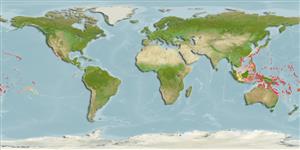
Holothuroidea |
Holothuriida |
Holothuriidae
Entorno: milieu / zona climática / rango de profundidad / gama de distribución
Ecología
Asociado a arrecife; rango de profundidad 0 - 25 m (Referencia 122), usually 5 - 15 m (Referencia 104244). Tropical
Pacific Ocean.
Longitud en la primera madurez / Tamaño / Peso / Edad
Madurez: Lm ? range ? - ? cm Max length : 40.0 cm TL macho / no sexado; (Referencia 122); common length : 30.0 cm TL macho / no sexado; (Referencia 122); peso máximo publicado: 500.00 g (Referencia 122); edad máxima reportada: 6 años (Referencia 104241)
Body-wall thickness: 0.6 cm (Ref. 122). Color: blackish-brown (appearing black at depth) over entire body, dorsal surface textured, anus terminal, papillae sparse and short, anal teeth nodulous or serrated (Ref. 104244).
A poorly known species. Collected by divers for artisanal fisheries, but not intensively so, as it is found in lower densities and has a deeper distribution than other "blackfish" species. Processed product is not distinguished from those of other Actinopyga species; moderate commercial value. Occurs in moderately shallow water; never found on reef flats, but on flagstones of reef slopes (Ref. 122), particularly on sand on fore reef slopes (Ref. 85218). On coarse sand with coral rubble. Also found on semi-sheltered bay reefs with boulders and coral rubble; seldom on lagoon reefs or inshore reefs (Ref. 92930). Populations reach medium densities up to 0.1 per square meter. A poorly known species (Ref. 122).
Ciclo vital y comportamiento de apareamiento
Madurez | Reproducción | Puesta | Huevos | Fecundidad | Larva
Conand, C. 1998 Holothurians (sea cucumbers, Class Holothuroidea). p. 1157-1190. In Carpenter, K.E. and V.H. Niem (eds.) FAO Species Identification Guide for Fishery Purposes. The Living Marine Resources of the Western Central Pacific. Vol. 2. Cephalopods, crustaceans, holothurians and sharks. FAO Rome. (Referencia 122)
Situación en la Lista Roja de la UICN
(Referencia 130435: Version 2025-2 (Global))
Estatus CITES (Referencia 108899)
Not Evaluated
CMS (Referencia 116361)
Not Evaluated
Amenaza para el ser humano
Harmless
Usos humanos
Pesquerías: comercial
FAO - Publication: search | FishSource |
Herramientas
Más información
Ecología TróficaAlimentos (presas)
Composición de la dieta
consumo de alimento
Despredadores
FisiologíaConsumo del oxígeno
Relacionados con el ser humanoSellos, monedas, varios
Fuentes de Internet
Estimaciones basadas en modelos
Vulnerabilidad pesquera
(Referencia 71543) |
Moderate vulnerability (36 of 100). |
Categoría de precios
(Referencia 80766): |
Unknown. |