Holothuroidea |
Holothuriida |
Holothuriidae
Umwelt: Milieu / Klimazone / Tiefenbereich / Verbreitungsgebiet
Ökologie
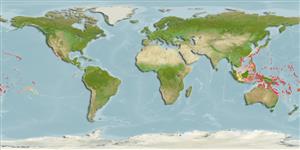
Riff-verbunden; tiefenbereich 0 - 25 m (Ref. 122), usually 5 - 15 m (Ref. 104244). Tropical
Pacific Ocean.
Länge bei der ersten Reifung / Größe / Gewicht / Alter
Geschlechtsreife: Lm ? range ? - ? cm Max length : 40.0 cm TL Männchen/unbestimmt; (Ref. 122); common length : 30.0 cm TL Männchen/unbestimmt; (Ref. 122); max. veröff. Gewicht: 500.00 g (Ref. 122); max. veröff. Alter: 6 Jahre (Ref. 104241)
Body-wall thickness: 0.6 cm (Ref. 122). Color: blackish-brown (appearing black at depth) over entire body, dorsal surface textured, anus terminal, papillae sparse and short, anal teeth nodulous or serrated (Ref. 104244).
A poorly known species. Collected by divers for artisanal fisheries, but not intensively so, as it is found in lower densities and has a deeper distribution than other "blackfish" species. Processed product is not distinguished from those of other Actinopyga species; moderate commercial value. Occurs in moderately shallow water; never found on reef flats, but on flagstones of reef slopes (Ref. 122), particularly on sand on fore reef slopes (Ref. 85218). On coarse sand with coral rubble. Also found on semi-sheltered bay reefs with boulders and coral rubble; seldom on lagoon reefs or inshore reefs (Ref. 92930). Populations reach medium densities up to 0.1 per square meter. A poorly known species (Ref. 122).
Lebenszyklus und Paarungsverhalten
Geschlechtsreife | Fortpflanzung | Ablaichen | Eier | Fruchtbarkeit | Larven
Conand, C. 1998 Holothurians (sea cucumbers, Class Holothuroidea). p. 1157-1190. In Carpenter, K.E. and V.H. Niem (eds.) FAO Species Identification Guide for Fishery Purposes. The Living Marine Resources of the Western Central Pacific. Vol. 2. Cephalopods, crustaceans, holothurians and sharks. FAO Rome. (Ref. 122)
IUCN Rote Liste Status
(Ref. 130435: Version 2025-2 (Global))
CITES Status (Ref. 108899)
Not Evaluated
Not Evaluated
Bedrohung für Menschen
Harmless
Nutzung durch Menschen
Fischereien: kommerziell
FAO - Publication: search | FishSource |
Tools
Mehr Information
Trophische ÖkologieLebensmittel (Beutetiere)
Nahrungszusammensetzung
Nahrungsaufnahme
Räuber
PhysiologieSauerstoffverbrauch
MenschenbezogenBriefmarken, Münzen, Verschiedenes.
Internet Quellen
Schätzungen auf der Grundlage von Modellen
Anfälligkeit der Fischerei
(Ref. 71543) |
Moderate vulnerability (36 of 100). |
Preiskategorie
(Ref. 80766): |
Unknown. |