Holothuroidea |
Holothuriida |
Holothuriidae
Umwelt: Milieu / Klimazone / Tiefenbereich / Verbreitungsgebiet
Ökologie
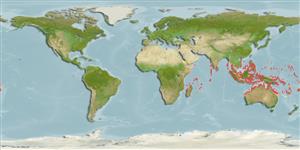
Riff-verbunden; tiefenbereich 0 - 20 m (Ref. 122), usually 0 - 12 m (Ref. 92930). Tropical; 30°N - 28°S, 32°E - 134°W
Indo- Pacific, including the Red Sea, but excluding the Persian Gulf and Hawaii.
Länge bei der ersten Reifung / Größe / Gewicht / Alter
Geschlechtsreife: Lm ? range ? - ? cm Max length : 35.0 cm TL Männchen/unbestimmt; (Ref. 122); common length : 25.0 cm TL Männchen/unbestimmt; (Ref. 122); max. veröff. Gewicht: 2.0 kg (Ref. 418)
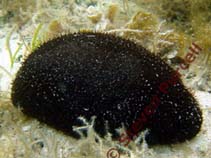
Body Width: 10 cm. Body thickness: 0.9 cm (Ref. 418); 6mm (Ref. 122). Body elongate, cylindrical, slightly arched dorsally (bivium) and flattened ventrally (trivium). Bivium covered by mucus and fine sediment. Papillae on bivium numerous, long and slender; long and thick podia on trivium arranged more or less regularly in tight rows on the radii; calcareous disc of podia around 700 micrometer in diameter. Mouth ventral, surround by 20 stout tentacles. Anus surrounded by 5 strong, triangular anal teeth. Calcareous ring with large radial pieces and narrow interradials. Cuvierian tubules absent. Color of bivium black; trivium lighter, dark brown. Spicules on ventral tegument with variety of simple or more complicated rosettes; dorsal tegument with rosette; ventral and dorsal podia with some rosettes; podia and papillae containing large spicules; tentacles with large rods.
Biology poorly known. Harvested by artisanal fisheries throughout the area. Collected by hand while wading on the reefs at low tide, or by divers. Processed product is not distinguished from those of other Actinopyga species; moderate commercial value. Maximum depth from Ref. 92930. Dwelling in moderately shallow waters; mostly on reef flats of fringing and lagoon-islet reefs, never on barrier reefs; common in sandy beds (Ref. 92930) and abundant in seagrass beds and on rubble reef flats where populations can reach high densities up to 1 square meter (Ref. 122). Feeds mainly on epiphytes and seagrass leaves (Ref. 122). Gregarious in nature (Ref. 118). Found in waters less than 30m, among rocks and boulders (Ref. 129602).
Lebenszyklus und Paarungsverhalten
Geschlechtsreife | Fortpflanzung | Ablaichen | Eier | Fruchtbarkeit | Larven
Conand, C. 1998 Holothurians (sea cucumbers, Class Holothuroidea). p. 1157-1190. In Carpenter, K.E. and V.H. Niem (eds.) FAO Species Identification Guide for Fishery Purposes. The Living Marine Resources of the Western Central Pacific. Vol. 2. Cephalopods, crustaceans, holothurians and sharks. FAO Rome. (Ref. 122)
IUCN Rote Liste Status
(Ref. 130435: Version 2025-2 (Global))
CITES Status (Ref. 108899)
Not Evaluated
Not Evaluated
Bedrohung für Menschen
Harmless
Nutzung durch Menschen
Fischereien: kommerziell
FAO - Publication: search | FishSource |
Tools
Mehr Information
LebenszyklusFortpflanzungGeschlechtsreifeFruchtbarkeitAblaichenEierEientwicklungLarven PhysiologieSauerstoffverbrauch
MenschenbezogenBriefmarken, Münzen, Verschiedenes.
Internet Quellen
Schätzungen auf der Grundlage von Modellen
Anfälligkeit der Fischerei
(Ref. 71543) |
Low vulnerability (25 of 100). |
Preiskategorie
(Ref. 80766): |
Unknown. |