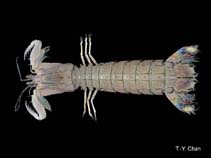
Malacostraca |
Stomatopoda |
Squillidae
環境: 環境 / 氣候帶 / 深度上下限 / 配送範圍
生態學
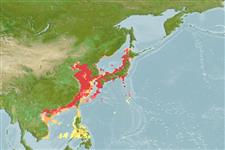
Benthic; 半鹹淡水; 深度上下限 10 - 100 m (參考文獻 3099). Subtropical; 46°N - 10°N, 106°E - 144°E
Western Pacific: from Vietnam to northern Japan, south to Bohol, Philippines. Introduced to Australia and New Zealand.
初熟時的長度 / 大小 / 重量 / 年齡
成熟度: Lm 9.6 range ? - ? cm Max length : 18.5 cm TL 雄魚/尚未辨別雌雄; (參考文獻 3099)
Maximum depth from Ref. 80410. Demersal (Ref. 105264). Burrows in near-shore level-bottom substrates (Ref. 92) in sheltered embayment or estuaries (Ref. 3099). Occurs in muddy bottoms of bays and inlets (Ref. 105263). Feeds mainly on crustaceans, mollusks, polychaetes, and fish; occasionally on plant materials (Ref. 105093).
生命週期和交配行為
成熟度 | 繁殖 | 產卵場 | 卵 | 孕卵數 | 仔魚
Some members of the order Stomatopoda pair for life and some come together only to mate. Males produce sperm ducts rather than spermatophores; females can brood a maximum of 50,000 eggs. Life cycle: Eggs hatch to a planktonic zoea which lasts for 3 months.
主要參考資料
參考文獻 | 合作者 | 合作者
Manning, R.B. 1998 Stromatopods. p. 827-849. In Carpenter, K.E. and V.H. Niem (eds.) FAO Species Identifidication Guide for Fishery Purposes. The Living Marine Resources of the Western Central Pacific. Vol. 2. Cephalopods, crustaceans, holothurians and sharks. FAO Rome. (參考文獻 92)
IUCN 瀕危狀態
(參考文獻 130435: Version 2025-2 (Global))
CITES狀態 (參考文獻 108899)
Not Evaluated
Not Evaluated
對人類具威脅
Harmless
人類使用
漁業: 商業性
FAO - Publication: search | FishSource | 周邊海洋
工具
網路資源
基於模型的估計
回復力
(Ref. 69278): |
高度, 族群倍增時間少於 15個月 (K=0.72-0.82) |
釣魚的脆弱性
(參考文獻 71543) |
Low vulnerability (13 of 100). |
價格種類
(參考文獻 80766): |
Very high. |
Nutrients
|
Calcium = 109 [35, 184] mg/100g; Iron = 1.59 [1.21, 1.97] mg/100g; Protein = 20.2 [19.2, 21.3] %; Omega3 = 0.285 [0.185, 0.386] g/100g; Selenium = 48.3 [-31.7, 128.3] μg/100g; VitaminA = 0 μg/100g; Zinc = 1.79 [1.17, 2.40] mg/100g (wet weight); based on nutrient studies. |