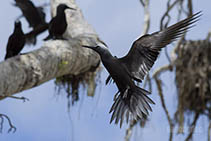
Aves |
Charadriiformes |
Laridae
Environnement : milieu / zone climatique / profondeur / gamme de distribution
Écologie
Others. Tropical; 33°N - 37°S, 104°E - 12°E
Indo-Pacific and Atlantic Ocean.
Longueur à la première maturité / Taille / Poids / Âge
Maturité: Lm ? range ? - ? cm Max length : 39.0 cm TL mâle / non sexé; (Réf. 8812); poids max. publié: 144.00 g (Réf. 356)
Description synthétique
Morphologie
Culmen: 3.72 cm; tarsus: 2.5 cm; wing: 23.5 cm.
Total Length: 35 to 39 cm; Wingspan: 66 (Ref. 8812) to 76 cm (Refs. 84934, 91362). Total population is over 200,000 pairs (Ref. 84934). Coastal to <10 km offshore (Ref. 356). Found on coastal rock, and over sea (Ref. 83946). Breeds annually in dense colonies, preferably in bushes and trees in Atlantic and Pacific Oceans (Ref. 84934). They are double-brooded. When there is danger, alarm calls are given by adults and chicks respond by crouching in place (Ref. 87784). Highly pelagic. Typically feeds far out at sea in large, gregarious flocks over shoals of predatory fish (Ref. 91362). Exhibits dipping and surface-seizing foraging behavior (Ref. 356). Feed mainly by dipping, hovering and picking from or just below the surface of the water. Also, shallow-plunging (Ref. 126735).
Cycle de vie et comportement reproducteur
Maturité | Reproduction | Frai | Œufs | Fécondité | Larves
Lusk, M.R., P. Bruner and C. Kessler 2000 The Avifauna of Farallon de Medinilla, Mariana Islands. Journal of Field Ornithology 71(1):22-33. (Réf. 5591)
Statut dans la liste rouge de l'IUCN
(Réf. 130435: Version 2025-2 (Global))
statut CITES (Réf. 108899)
Not Evaluated
Not Evaluated
Menace pour l'homme
Utilisations par l'homme
FAO - Publication: search | FishSource |
Outils
Plus d'informations
Dynamique des populationsCroissanceÂges / tailles maximalesLongueur-poids rel.Rel. longueur-longueur.Fréquences de longueursConversion de masseAbondance Cycle de vieReproductionMaturitéFéconditéFraiŒufsDéveloppement de l'œufLarves PhysiologieConsommation d'oxygène
Liées à l'hommeTimbres, pièces de monnaie, divers
Sources Internet
Estimations basées sur des modèles
Résilience
(Ref. 69278): |
Haut, temps minimum de doublement de population inférieur à 15 mois (K=42.36) |
Vulnérabilité de la pêche
(Réf. 71543) |
Low to moderate vulnerability (29 of 100). |
Catégorie de prix
(Réf. 80766): |
Unknown. |