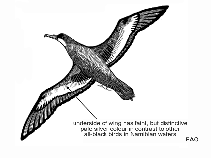
Aves |
Procellariiformes |
Procellariidae
Meio ambiente: milieu / Zona climática / intervalo de profundidade / faixa de distribuição
Ecologia
Others; intervalo de profundidade 0 - 93 m (Ref. 120202), usually 20 - 70 m (Ref. 120202). Temperate; 65°N - 67°S, 180°W - 180°E (Ref. 125423)
Circumglobal.
Comprimento de primeira maturação / Tamanho / Peso / Idade
Maturidade: Lm ? range ? - ? cm Max length : 46.0 cm TL macho/indeterminado; (Ref. 8812); peso máx. publicado: 869.00 g (Ref. 356)
Culmen: 4.14 cm; tarsus: 5.67 cm; wing: 30.0 cm.
Total Length: 40 to 46 cm; Wingspan: 94 to 104 cm (Ref. 8812). Wingspan: 105 cm (Ref. 91362). Nocturnal (Ref. 87784). Exhibits pursuit plunging and surface diving (Ref. 356). Gregarious at sea. Does not typically trail ships (Ref. 91362). Mean maximum diving depth on foraging trips, 39 m, and greatest depth recorded at 67 m. During the northern summer, migrates from the Antipodes into the North Pacific. In New Zealand, displaced their foraging competitors, the Antarctic Terns (Sterna vittata) from crustacean swarms by agitating the tern flock and covering the foraging surface in dense rafts. Does not breed in the North Pacific despite multitudes spending austral winter there after their long transequatorial migration from breeding areas in Australia and New Zealand (Ref. 87784). Colonial breeder (Ref. 91362) at sub-antarctic islands (Refs. 356, 91362). Winters in the sub-topical Pacific (Ref. 356). Burrow- and crevice-nesting; early in nesting cycle, wander in and out of burrows; burrows without breeding owners having as much as 10 different individuals within a single season. Population declines linked to fish-net mortality (Ref. 87784).
Ciclo de vida ou comportamento de acasalamento
Maturidade | Reprodução | Desova | Ovos | Fecundidade | Larvas
Lepage, D. 2007 Avibase -the World Bird Database. http://www.bsc-eoc.org/avibase/avibase.jsp [accessed 09/07/2007]. (Ref. 7816)
Status na Lista Vermelha da UICN
(Ref. 130435: Version 2025-2 (Global))
Status no CITES (Ref. 108899)
Not Evaluated
Not Evaluated
Ameaça para os humanos
Uso pelos humanos
FAO - Publication: search | FishSource |
Ferramentas
Mais informação
Dinâmica populacionalCrescimentoIdade máxima / tamanhosRelação comprimento-peso.Relação comprimento-comprimento.Frequências de comprimentoConversão de massaAbundância Ciclo de vidaReproduçãoMaturidadeFecundidadeDesovaOvosDesenvolvimento dos ovosLarvas FisiologiaConsumo de oxigênio
Relacionado a humanosSelos, moedas, diversos.
Fontes da internet
Estimativas baseadas em modelos
Vulnerabilidade da pesca
(Ref. 71543) |
Moderate vulnerability (36 of 100). |
Categoria de preço
(Ref. 80766): |
Unknown. |