Mammalia |
Carnivora |
Phocidae
Entorno: milieu / zona climática / rango de profundidad / gama de distribución
Ecología
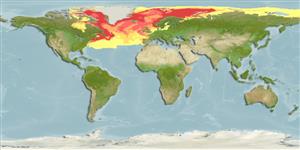
Batidemersal; rango de profundidad 0 - 6000 m (Referencia 356). Boreal; 90°N - 0°S, 97°W - 180°E
Distribución
Territories | Áreas FAO | Ecosistemas | Ocurrencias, apariciones | Introducciones
Atlantic Ocean and the Arctic: North Atlantic Ocean, Arctic Ocean, Baffin Island, Magdalen Island, Russia, Canada (Ref. 1394). Pagophilus groenlandicus groenlandicus: Newfoundland, Jan Mayen (Norway), Baffin Bay, Greenland Sea, Nova Scotia, Greenland, Iceland; and vagrants in Virginia, Scotland, Germany, France; Pagophilus groenlandicus oceanicus: Barents Sea, Russia, White Sea (Ref. 1522).
Longitud en la primera madurez / Tamaño / Peso / Edad
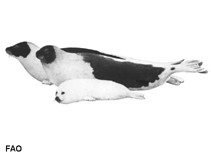
Madurez: Lm ? range ? - ? cm Max length : 190 cm TL macho / no sexado; (Referencia 1394); 180 cm TL (female); peso máximo publicado: 135.0 kg (Referencia 1394); peso máximo publicado: 135.0 kg
Live chiefly in pack ice, but can be found away from it in summer. Feeds on a variety of crustaceans and open-water fishes during migration, and switch to several varieties of bottom dwelling fishes in summer on the northern grounds (Ref. 1394). Live chiefly in pack ice, but can be found away from it in summer (Ref. 1394). Adults are highly gregarious; young seals tend to be solitary. Typically forms aggregations when feeding (Ref. 117964). Feeds on a variety of crustaceans and open-water fishes during migration, and switch to several varieties of bottom dwelling fishes in summer on the northern grounds (Ref. 1394).
Ciclo vital y comportamiento de apareamiento
Madurez | Reproducción | Puesta | Huevos | Fecundidad | Larva
Jefferson, T.A., S. Leatherwood and M.A. Webber 1993 FAO species Identification Guide: Marine Mammals of the World. Rome, FAO. 320 p. + 587 figures. (Referencia 1394)
Situación en la Lista Roja de la UICN
(Referencia 130435: Version 2025-2 (Global))
Estatus CITES (Referencia 108899)
Not Evaluated
CMS (Referencia 116361)
Not Evaluated
Amenaza para el ser humano
Usos humanos
Pesquerías: comercial
FAO - pesquerías: perfil de la especie, landings search; Publication: search | FIRMS (Stock assessments) | FishSource | Sea Around Us
Herramientas
Más información
Ciclo de vidaReproducciónMadurezFecundidadPuestaHuevosDesarrollo de los huevosLarva FisiologíaConsumo del oxígeno
Relacionados con el ser humanoSellos, monedas, varios
Fuentes de Internet
Estimaciones basadas en modelos
Vulnerabilidad pesquera
(Referencia 71543) |
High to very high vulnerability (71 of 100). |
Categoría de precios
(Referencia 80766): |
Unknown. |