Mammalia |
Carnivora |
Phocidae
Environnement : milieu / zone climatique / profondeur / gamme de distribution
Écologie
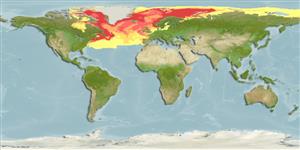
Bathydémersal; profondeur 0 - 6000 m (Réf. 356). Boreal; 90°N - 0°S, 97°W - 180°E
Atlantic Ocean and the Arctic: North Atlantic Ocean, Arctic Ocean, Baffin Island, Magdalen Island, Russia, Canada (Ref. 1394). Pagophilus groenlandicus groenlandicus: Newfoundland, Jan Mayen (Norway), Baffin Bay, Greenland Sea, Nova Scotia, Greenland, Iceland; and vagrants in Virginia, Scotland, Germany, France; Pagophilus groenlandicus oceanicus: Barents Sea, Russia, White Sea (Ref. 1522).
Longueur à la première maturité / Taille / Poids / Âge
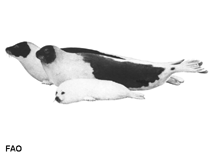
Maturité: Lm ? range ? - ? cm Max length : 190 cm TL mâle / non sexé; (Réf. 1394); 180 cm TL (female); poids max. publié: 135.0 kg (Réf. 1394); poids max. publié: 135.0 kg
Live chiefly in pack ice, but can be found away from it in summer. Feeds on a variety of crustaceans and open-water fishes during migration, and switch to several varieties of bottom dwelling fishes in summer on the northern grounds (Ref. 1394). Live chiefly in pack ice, but can be found away from it in summer (Ref. 1394). Adults are highly gregarious; young seals tend to be solitary. Typically forms aggregations when feeding (Ref. 117964). Feeds on a variety of crustaceans and open-water fishes during migration, and switch to several varieties of bottom dwelling fishes in summer on the northern grounds (Ref. 1394).
Cycle de vie et comportement reproducteur
Maturité | Reproduction | Frai | Œufs | Fécondité | Larves
Jefferson, T.A., S. Leatherwood and M.A. Webber 1993 FAO species Identification Guide: Marine Mammals of the World. Rome, FAO. 320 p. + 587 figures. (Réf. 1394)
Statut dans la liste rouge de l'IUCN
(Réf. 130435: Version 2025-2 (Global))
statut CITES (Réf. 108899)
Not Evaluated
Not Evaluated
Menace pour l'homme
Utilisations par l'homme
Pêcheries: commercial
FAO - pêcheries: Résumé espèce, landings search; Publication: search | FIRMS (Stock assessments) | FishSource | Sea Around Us
Outils
Plus d'informations
Dynamique des populations Cycle de vieReproductionMaturitéFéconditéFraiŒufsDéveloppement de l'œufLarves PhysiologieConsommation d'oxygène
Liées à l'hommeTimbres, pièces de monnaie, divers
Sources Internet
Estimations basées sur des modèles
Vulnérabilité de la pêche
(Réf. 71543) |
High to very high vulnerability (71 of 100). |
Catégorie de prix
(Réf. 80766): |
Unknown. |