Mammalia |
Cetartiodactyla |
Balaenidae
Miljö: miljö / Klimatzon / djupintervall / distributionsområde
Ekologi
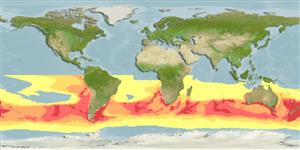
Pelagiska. Tropical; 0°N - 90°S, 180°W - 180°E
Southern hemisphere: Antarctic to temperate waters; occasionally along the northern part of the Antarctic Peninsula. [Chile-Peru population: IUCN 2010 (Ref. 84930): CR, D.]
Längd vid första mognad / Storlek / Vikt / Ålder
Könsmognad: Lm ? range ? - ? cm Max length : 1,700 cm TL hane/ej könsbestämd; (Ref. 1394); publicerad maxvikt: 100.0 t (Ref. 1394)
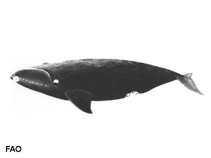
Inhabits oceanic regions. It preys on copepods and krill, particularly on the surface or subsurface skim feeding. Southern right whale populations, like their northern counterparts, have been heavily depleted by commercial whaling. Although not as endangered as the northern’ species, southern right whale populations are still relatively small. Although fully protected by the IWC, there is probably still some hunting for right whales. Despite the threats from whaling, entanglement in fishing gear, vessel collisions, and habitat destruction, some southern right whale populations have shown recent signs of recovery (Ref. 1394). Surface and subsurface skim feeding. Feeds on copepods and krill, apparently sometimes feeding near the bottom (Ref. 1394).
Livscykel och parningsbeteende
Könsmognad | Reproduktion | Lek | Ägg | Fekunditet | Larver
Jefferson, T.A., S. Leatherwood and M.A. Webber 1993 FAO species Identification Guide: Marine Mammals of the World. Rome, FAO. 320 p. + 587 figures. (Ref. 1394)
Status på IUCN:s rödlista
(Ref. 130435: Version 2025-2 (Global))
CITES-status (Ref. 108899)
Hot mot människor
Mänskliga användningsområden
Fiskeri: kommersiell
FAO - fiskeri: artprofil, landings search; Publication: search | FishSource | Havet omkring oss
Verktyg
Ytterligare information
Trofisk ekologiLivsmedelsartiklar (preys)
Födosammansättning
Födointag
Predatorer
MänniskorelateradFrimärken, mynt, diverse.
Internet-källor
Uppskattningar baserade på modeller
Sårbarhet i fisket
(Ref. 71543) |
Very high vulnerability (90 of 100). |
Priskategori
(Ref. 80766): |
Unknown. |