Mammalia |
Cetartiodactyla |
Balaenidae
Environnement : milieu / zone climatique / profondeur / gamme de distribution
Écologie
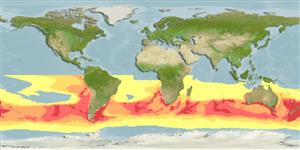
Pélagique. Tropical; 0°N - 90°S, 180°W - 180°E
Southern hemisphere: Antarctic to temperate waters; occasionally along the northern part of the Antarctic Peninsula. [Chile-Peru population: IUCN 2010 (Ref. 84930): CR, D.]
Longueur à la première maturité / Taille / Poids / Âge
Maturité: Lm ? range ? - ? cm Max length : 1,700 cm TL mâle / non sexé; (Réf. 1394); poids max. publié: 100.0 t (Réf. 1394)
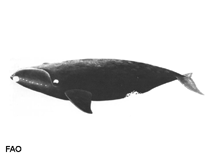
Inhabits oceanic regions. It preys on copepods and krill, particularly on the surface or subsurface skim feeding. Southern right whale populations, like their northern counterparts, have been heavily depleted by commercial whaling. Although not as endangered as the northern’ species, southern right whale populations are still relatively small. Although fully protected by the IWC, there is probably still some hunting for right whales. Despite the threats from whaling, entanglement in fishing gear, vessel collisions, and habitat destruction, some southern right whale populations have shown recent signs of recovery (Ref. 1394). Surface and subsurface skim feeding. Feeds on copepods and krill, apparently sometimes feeding near the bottom (Ref. 1394).
Cycle de vie et comportement reproducteur
Maturité | Reproduction | Frai | Œufs | Fécondité | Larves
Jefferson, T.A., S. Leatherwood and M.A. Webber 1993 FAO species Identification Guide: Marine Mammals of the World. Rome, FAO. 320 p. + 587 figures. (Réf. 1394)
Statut dans la liste rouge de l'IUCN
(Réf. 130435: Version 2025-2 (Global))
statut CITES (Réf. 108899)
Menace pour l'homme
Utilisations par l'homme
Pêcheries: commercial
FAO - pêcheries: Résumé espèce, landings search; Publication: search | FishSource | Sea Around Us
Outils
Plus d'informations
Écologie trophiqueAliments (proies)
Composition du régime alimentaire
Consommation alimentaire
Prédateurs
Dynamique des populationsCroissanceÂges / tailles maximalesLongueur-poids rel.Rel. longueur-longueur.Fréquences de longueursConversion de masseAbondance PhysiologieConsommation d'oxygène
Liées à l'hommeTimbres, pièces de monnaie, divers
Sources Internet
Estimations basées sur des modèles
Vulnérabilité de la pêche
(Réf. 71543) |
Very high vulnerability (90 of 100). |
Catégorie de prix
(Réf. 80766): |
Unknown. |