Mammalia |
Sirenia |
Dugongidae
Environnement : milieu / zone climatique / profondeur / gamme de distribution
Écologie
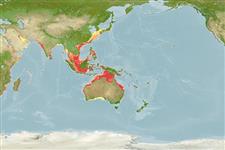
Benthopélagique; profondeur 0 - 200 m (Réf. 81173), usually 1 - 40 m. Tropical; 30°N - 37°S, 32°E - 178°W
Indo-Pacific: Dugong dugon hemprichii: Red Sea, Aqaba, Suez Canal; Dugong dugon dugon: Gulf of Aden, Mozambique, Persian Gulf, Pakistan, India, Myanmar, Malay Peninsula, Gulf of Thailand, Vietnam, Gulf of Tonkin, Comoros, Madagascar, Mauritius, Rodriguez, Sri Lanka, Andaman Islands, Indonesia, Ryukyu, Taiwan, Philippines, Guam, Palau, Micronesia, Caroline Is, Papua New Guinea, Solomon, New Caledonia, Australia, Fiji (Ref. 1522).
Longueur à la première maturité / Taille / Poids / Âge
Maturité: Lm ? range ? - ? cm Max length : 406 cm TL mâle / non sexé; (Réf. 91927); poids max. publié: 400.0 kg (Réf. 1394); âge max. reporté: 20 années (Réf. 91927)
Maximum diving depth of 20.5 m recorded from Australia (Ref. 81173). Found in inshore waters, in bays and channels (Ref. 1394). Favors areas with warm shallow water, inshore and reefal seagrass beds (Ref. 936), particularly on fine sand (Ref. 86921). Occurs in small groups of up to 6 individuals; though, an exception of a herd of to 600 individuals was once recorded between Bahrain and Qatar (Ref. 801). Population estimates in the Persian/Arabian Gulf range from 5800 to 7300 individuals. Has a larger range than previously known, where their present range may be about 74% of the historical range (Ref. 114880). Feeds on a variety of seagrasses (Ref. 936). Almost entirely dependent on seagrass for food (Ref. 114880). Preyed upon by tiger sharks (Ref. 49538). Faces threats in the Persian/Arabian Gulf such as dredging, trawling and land reclamation, all damaging their critical seagrass habitats (Ref. 114880).
Cycle de vie et comportement reproducteur
Maturité | Reproduction | Frai | Œufs | Fécondité | Larves
Tan, J.M.L. 1995 A Field Guide to the Whales and Dolphins in the Philippines. Makati City: Bookmark. 125 p. (Réf. 936)
Statut dans la liste rouge de l'IUCN
(Réf. 130435: Version 2025-2 (Global))
statut CITES (Réf. 108899)
Menace pour l'homme
Utilisations par l'homme
Pêcheries: sans intérêt
FAO - pêcheries: Résumé espèce; Publication: search | FishSource | Sea Around Us
Outils
Plus d'informations
Dynamique des populations PhysiologieConsommation d'oxygène
Liées à l'hommeTimbres, pièces de monnaie, divers
Sources Internet
Estimations basées sur des modèles
Résilience
(Ref. 69278): |
Haut, temps minimum de doublement de population inférieur à 15 mois (K=1.26-1.62; tm=12.3; tmax=20) |
Vulnérabilité de la pêche
(Réf. 71543) |
High vulnerability (59 of 100). |
Catégorie de prix
(Réf. 80766): |
Unknown. |