Mammalia |
Sirenia |
Dugongidae
Milieu: milieu / Klimaatzone / Diepte / verspreidingsgebied
Ecologie
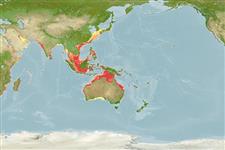
Benthopelagisch; diepte 0 - 200 m (Ref. 81173), usually 1 - 40 m. Tropical; 30°N - 37°S, 32°E - 178°W
Indo-Pacific: Dugong dugon hemprichii: Red Sea, Aqaba, Suez Canal; Dugong dugon dugon: Gulf of Aden, Mozambique, Persian Gulf, Pakistan, India, Myanmar, Malay Peninsula, Gulf of Thailand, Vietnam, Gulf of Tonkin, Comoros, Madagascar, Mauritius, Rodriguez, Sri Lanka, Andaman Islands, Indonesia, Ryukyu, Taiwan, Philippines, Guam, Palau, Micronesia, Caroline Is, Papua New Guinea, Solomon, New Caledonia, Australia, Fiji (Ref. 1522).
Lengte bij maturiteit / Grootte / Gewicht / Leeftijd
Maturiteit: Lm ? range ? - ? cm Max length : 406 cm TL mannelijk / geslacht onbekend; (Ref. 91927); max. gepubliceerd gewicht: 400.0 kg (Ref. 1394); max. gerapporteerde leeftijd: 20 Jaren (Ref. 91927)
Maximum diving depth of 20.5 m recorded from Australia (Ref. 81173). Found in inshore waters, in bays and channels (Ref. 1394). Favors areas with warm shallow water, inshore and reefal seagrass beds (Ref. 936), particularly on fine sand (Ref. 86921). Occurs in small groups of up to 6 individuals; though, an exception of a herd of to 600 individuals was once recorded between Bahrain and Qatar (Ref. 801). Population estimates in the Persian/Arabian Gulf range from 5800 to 7300 individuals. Has a larger range than previously known, where their present range may be about 74% of the historical range (Ref. 114880). Feeds on a variety of seagrasses (Ref. 936). Almost entirely dependent on seagrass for food (Ref. 114880). Preyed upon by tiger sharks (Ref. 49538). Faces threats in the Persian/Arabian Gulf such as dredging, trawling and land reclamation, all damaging their critical seagrass habitats (Ref. 114880).
Levenscyclus en paargedrag
Maturiteit | Voortplanting | Paaien | Eieren | Fecunditeit | Larven
Tan, J.M.L. 1995 A Field Guide to the Whales and Dolphins in the Philippines. Makati City: Bookmark. 125 p. (Ref. 936)
Status op de Rode Lijst van het IUCN
(Ref. 130435: Version 2025-2 (Global))
CITES status (Ref. 108899)
Gevaar voor de mens
Gebruik door de mens
Visserij: van geen belang
FAO - visserij: soortsprofiel; Publication: search | FishSource | Sea Around Us
Tools
Meer informatie
FysiologieZuurstofverbruik
Menselijk gerelateerdPostzegels, munten, diversen.
Internetbronnen
Schattingen op basis van modellen
Weerstandsvermogen
(Ref. 69278): |
Hoog, minimale populatieverdubbelingstijd minder dan 15 maanden (K=1.26-1.62; tm=12.3; tmax=20) |
Kwetsbaarheid van de visserij
(Ref. 71543) |
High vulnerability (59 of 100). |
Prijsklasse
(Ref. 80766): |
Unknown. |