Mammalia |
Carnivora |
Otariidae
Entorno: milieu / zona climática / rango de profundidad / gama de distribución
Ecología
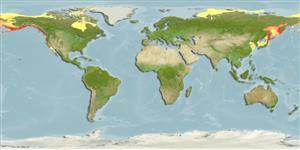
Batidemersal. Subtropical; 90°N - 0°S, 180°W - 180°E
Pacific Ocean, Northeast Atlantic and the Arctic. Tropical to temperate.
Longitud en la primera madurez / Tamaño / Peso / Edad
Madurez: Lm ? range ? - ? cm Max length : 330 cm TL macho / no sexado; (Referencia 1394); 250 cm TL (female); common length : 310 cm TL macho / no sexado; (Referencia 80659); common length :240 cm TL (female); peso máximo publicado: 1.1 t (Referencia 80659); peso máximo publicado: 1.1 t
Sexually dimorphic. Coloration when dry is pale yellow to light tan with dark brown undersides and near their flippers. When wet, color is grayish white. Pelage is short coarse hairs. Mature males develop a prominent mane on the necks and chests, with heads that are more robust with a flatter snout than females.
Inhabits coastal and immediate offshore waters (Ref. 1522). Preyed upon by great white sharks (Ref. 32140). Coastal and immediate offshore waters (Ref. 1522). Non-migratory but may disperse considerably from breeding sites. Appears to feed along the continental shelf and break (Ref. 80660). Found from the coast to the outer continental shelf; they frequent deep oceanic waters in some parts of the range. Feeds on many varieties of fish and squid, prefers bottom species; feeding occurs at night (Ref. 1394).
Ciclo vital y comportamiento de apareamiento
Madurez | Reproducción | Puesta | Huevos | Fecundidad | Larva
Only sexually mature Steller sea lions return to rookeries, except for few dependent young with their mothers. Gestation results only one pup which is nursed for under a year up to 3 years. Mothers stay on shore with their newborn for about a week before leaving for regular feeding trips. Copulation usually occur prior to first feeding trip. Longevity lasts about 14 years for males and 22 years for females, with a generation time of 10 years.
Rice, D.W. 1998 Marine Mammals of the World Systematics and Distribution. Special Publication number 4: The Society for Marine Mammalogy. 231p. (Referencia 1522)
Situación en la Lista Roja de la UICN
(Referencia 130435: Version 2025-2 (Global))
Estatus CITES (Referencia 108899)
Not Evaluated
CMS (Referencia 116361)
Not Evaluated
Amenaza para el ser humano
Usos humanos
Pesquerías: comercial
FAO - pesquerías: perfil de la especie, landings search; Publication: search | FishSource | Sea Around Us
Herramientas
Más información
Ciclo de vidaReproducciónMadurezFecundidadPuestaHuevosDesarrollo de los huevosLarva FisiologíaConsumo del oxígeno
Relacionados con el ser humanoSellos, monedas, varios
Fuentes de Internet
Estimaciones basadas en modelos
Resiliencia
(Ref. 69278): |
Medio, población duplicada en un tiempo mínimo de 1.4-4.4 años (K=0.17-0.54) |
Vulnerabilidad pesquera
(Referencia 71543) |
High to very high vulnerability (72 of 100). |
Categoría de precios
(Referencia 80766): |
Unknown. |