Mammalia |
Carnivora |
Otariidae
Environnement : milieu / zone climatique / profondeur / gamme de distribution
Écologie
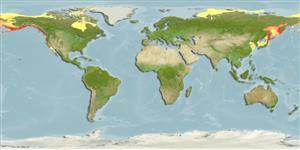
Bathydémersal. Subtropical; 90°N - 0°S, 180°W - 180°E
Pacific Ocean, Northeast Atlantic and the Arctic. Tropical to temperate.
Longueur à la première maturité / Taille / Poids / Âge
Maturité: Lm ? range ? - ? cm Max length : 330 cm TL mâle / non sexé; (Réf. 1394); 250 cm TL (female); common length : 310 cm TL mâle / non sexé; (Réf. 80659); common length :240 cm TL (female); poids max. publié: 1.1 t (Réf. 80659); poids max. publié: 1.1 t
Description synthétique
Morphologie
Sexually dimorphic. Coloration when dry is pale yellow to light tan with dark brown undersides and near their flippers. When wet, color is grayish white. Pelage is short coarse hairs. Mature males develop a prominent mane on the necks and chests, with heads that are more robust with a flatter snout than females.
Inhabits coastal and immediate offshore waters (Ref. 1522). Preyed upon by great white sharks (Ref. 32140). Coastal and immediate offshore waters (Ref. 1522). Non-migratory but may disperse considerably from breeding sites. Appears to feed along the continental shelf and break (Ref. 80660). Found from the coast to the outer continental shelf; they frequent deep oceanic waters in some parts of the range. Feeds on many varieties of fish and squid, prefers bottom species; feeding occurs at night (Ref. 1394).
Cycle de vie et comportement reproducteur
Maturité | Reproduction | Frai | Œufs | Fécondité | Larves
Only sexually mature Steller sea lions return to rookeries, except for few dependent young with their mothers. Gestation results only one pup which is nursed for under a year up to 3 years. Mothers stay on shore with their newborn for about a week before leaving for regular feeding trips. Copulation usually occur prior to first feeding trip. Longevity lasts about 14 years for males and 22 years for females, with a generation time of 10 years.
Rice, D.W. 1998 Marine Mammals of the World Systematics and Distribution. Special Publication number 4: The Society for Marine Mammalogy. 231p. (Réf. 1522)
Statut dans la liste rouge de l'IUCN
(Réf. 130435: Version 2025-2 (Global))
statut CITES (Réf. 108899)
Not Evaluated
Not Evaluated
Menace pour l'homme
Utilisations par l'homme
Pêcheries: commercial
FAO - pêcheries: Résumé espèce, landings search; Publication: search | FishSource | Sea Around Us
Outils
Plus d'informations
Dynamique des populations Cycle de vieReproductionMaturitéFéconditéFraiŒufsDéveloppement de l'œufLarves PhysiologieConsommation d'oxygène
Liées à l'hommeTimbres, pièces de monnaie, divers
Sources Internet
Estimations basées sur des modèles
Résilience
(Ref. 69278): |
Milieu, temps minimum de doublement de population : 1,4 à 4,4 années (K=0.17-0.54) |
Vulnérabilité de la pêche
(Réf. 71543) |
High to very high vulnerability (72 of 100). |
Catégorie de prix
(Réf. 80766): |
Unknown. |