Mammalia |
Cetartiodactyla |
Delphinidae
Miljö: miljö / Klimatzon / djupintervall / distributionsområde
Ekologi
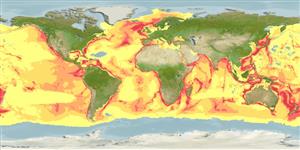
Pelagiska; havsvandrande (Ref. 75906); brackvatten; djupintervall 0 - 3510 m (Ref. 116169). Tropical; 13°C - 28°C (Ref. 75906); 90°N - 90°S, 180°W - 180°E
Atlantic, the Mediterranean, Indo-Pacific and the Antarctic. Tropical to temperate.
Längd vid första mognad / Storlek / Vikt / Ålder
Könsmognad: Lm ? range ? - ? cm Max length : 380 cm TL hane/ej könsbestämd; (Ref. 1394); publicerad maxvikt: 500.0 kg (Ref. 1394)
Inhabits deep oceanic and continental slope waters of the tropics through the temperate regions in both hemispheres. Feeds in deeper waters (Ref. 122680) on crustaceans and cephalopods, but prefers squid (Ref. 1394). Feeding strategy involves synchronized, individual hunting for non-schooling prey such as deep-sea squids (Ref. 130961).
Livscykel och parningsbeteende
Könsmognad | Reproduktion | Lek | Ägg | Fekunditet | Larver
Breeding is year-round.
Tan, J.M.L. 1995 A Field Guide to the Whales and Dolphins in the Philippines. Makati City: Bookmark. 125 p. (Ref. 936)
Status på IUCN:s rödlista
(Ref. 130435: Version 2025-2 (Global))
CITES-status (Ref. 108899)
Hot mot människor
Mänskliga användningsområden
Fiskeri: kommersiell
FAO - fiskeri: artprofil, landings search; Publication: search | FishSource | Havet omkring oss
Verktyg
Ytterligare information
MänniskorelateradFrimärken, mynt, diverse.
Internet-källor
Uppskattningar baserade på modeller
Resiliens
(Ref. 69278): |
Hög, lägsta populationsfördubblingstid mindre än 15 månader (K=0.49-0.57; tm=11) |
Sårbarhet i fisket
(Ref. 71543) |
High to very high vulnerability (69 of 100). |
Priskategori
(Ref. 80766): |
Unknown. |