Mammalia |
Cetartiodactyla |
Balaenopteridae
Окружающая среда: среда / климатическая зона / пределы глубины / диапазон распространения
экология
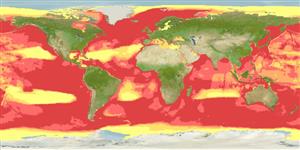
пелагический; мигрирует в океане (ссылка 75906); пределы глубины 0 - 616 m (ссылка 83346). Tropical; 90°N - 90°S, 180°W - 180°E
Circumglobal. [Arabian Sea population: EN, D; Oceania population: EN, A1ad: IUCN 2010 (Ref. 84930)].
Длина при первой зрелости / Размер / Вес / Возраст
половая зрелость: Lm ? range ? - ? cm Max length : 1,890 cm TL самец/пол неопределен; (ссылка 936); наибольший вес (опубликованные данные): 35.0 t (ссылка 1394)
They migrate from tropics (breeding areas) to polar or sub-polar regions, reaching the ice edges in both hemispheres (feeding areas); their migrations take them through oceanic zones (Ref. 1394). Maximum depth from Ref. 122827. Feed and breed in coastal waters, often near human population centres, and this helps make them one of the most familiar of the large whales. Feeds on krill and small schooling fish (Ref. 1394). According to a study in the Philippines, Babuyan Islands (121°36’00", 19°18’00) was verified as a breeding ground for this species, and humpback whale songs were recorded during this season. Social groups observed were lone adult, mother-calf pairs, two adults, mother-calf-escort, and a surface active mating group of 3 to 4 individuals (Ref. 77119). Adults length 1600 cm in Ref. 1394. Threats to this species are dynamite and cyanide fishing, pollution, and intrusion of foreign commercial fishing vessels (Ref. 77119), unregulated fishing activities of Taiwanese vessels, i.e. long-line and drift net fishing, and unconfirmed reports of pirate whaling (Ref. 77118). There were nine distinctive themes of humpback whale songs identified wherein 7 of which were common in the Philippines and Hawaii (Ref. 77118). Feeds and breeds in coastal waters, often near human population centres, and this helps make them one of the most familiar of the large whales. They migrate from tropics (breeding areas) to polar or sub-polar regions, reaching the ice edges in both hemispheres (feeding areas); their migrations take them through oceanic zones (Ref. 1394). They prefer warm shallow waters to breed, usually near offshore reefs, islands, or continental shores. Feeding grounds are characterized by cold, productive, shallow waters (Ref. 122680). Feeds on krill and small schooling fish (Ref. 1394). According to a study in the Philippines, Babuyan Islands (121°36’00", 19°18’00) was verified as a breeding ground for this species, and humpback whale songs were recorded during this season. Social groups observed were lone adult, mother-calf pairs, two adults, mother-calf-escort, and a surface active mating group of 3 to 4 individuals (Ref. 77119).
Жизненный цикл и брачное поведение
половая зрелость | размножение | нерест | икра | Плодовитость | личинки
Babuyan Islands (121°36’00", 19°18’00"), Philippines was verified as a breeding ground for this species. During this season social groups observed were lone adult, mother-calf pairs, two adults, mother-calf-escort, and a surface active mating group of 3 to 4 individuals (Ref. 77119). Associated activities involved cows with young calves escorted by males, aggressive competitive behavior, and singing (Ref. 78067).
Основная ссылка
ссылки | координатор | соавторы
Jefferson, T.A., S. Leatherwood and M.A. Webber 1993 FAO species Identification Guide: Marine Mammals of the World. Rome, FAO. 320 p. + 587 figures. (ссылка 1394)
Статус Красного Списка МСОП
(ссылка 130435: Version 2025-2 (Global))
Статус СИТЕС (ссылка 108899)
CMS (ссылка 116361)
Угроза для людей
Использование человеком
рыболовство: коммерческий
FAO - рыболовство: Видовой профиль, landings search; Publication: search | FishSource | Море вокруг нас
инструменты
дополнительная информация
Динамика численности населения ФизиологияПотребление кислорода
Связанные с человекомМарки, монеты и прочее.
Информационно-просветительская работа
ресурсы в Интернет
Оценки, основанные на моделях
устойчивость к внешним воздействиям
(Ref. 69278): |
высокий, минимальное время удвоения популяции до 15 месяцев (K=0.25-1.96; tm=6) |
Уязвимость рыбной ловли
(ссылка 71543) |
High vulnerability (60 of 100). |
Категория цены
(ссылка 80766): |
Unknown. |